Rahul Gandhi: Minister for Other People’s Plates
Total Views |


There are moments in politics when a leader is confronted with an inconvenient success.b The sensible response is to acknowledge it. The political response is to look elsewhere. And the Rahul Gandhi response, apparently, is to look at the dinner plate.
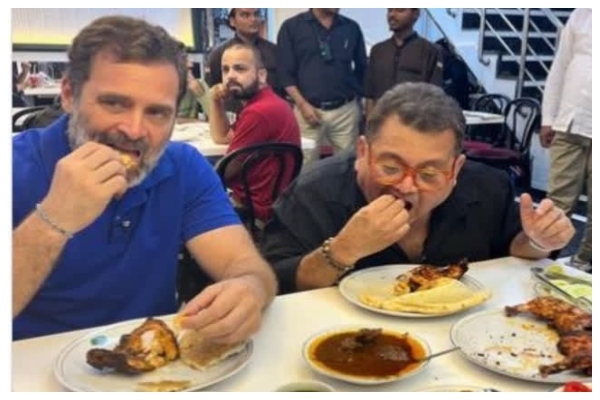
BRICS is becoming an increasingly consequential grouping. India is playing a visible role in it. The diplomatic photographs are not particularly helpful to those who have spent years suggesting that India is somehow isolated from the world. But there is a limit to what an Opposition leader can do about BRICS. He cannot cancel the summit. He cannot rearrange the photographs. He cannot ask the other countries to please stop making India's international position look more substantial. So what is left? Food. At least the dinner plate is within reach.
This is where Indian politics may have discovered a new strategic doctrine: when geopolitics refuses to cooperate, move to gastronomy. The advantage is obvious. Foreign policy requires facts, negotiations, economic arguments and an inconvenient familiarity with the outside world. Food requires only an opinion.
ALSO READ: UK Faces Historic Breakup Push as Devolved Leaders Plan Joint Summit in Cardiff
Perhaps this is the beginning of a new political portfolio. Minister for Breakfast. Leader of the Opposition for Lunch. National Convenor for Dinner. A parliamentary standing committee could examine whether biryani is sufficiently progressive, whether dal is ideologically neutral and whether a person eating a samosa has demonstrated adequate commitment to constitutional values. There could even be a new political test.
Before entering public life, every politician might be required to declare: Vegetarian or non-vegetarian? Tea or coffee? Spicy or mild? Breakfast before 9 a.m. or after? The nation would finally know where its leaders stand on the really important issues. Of course, this is satire. But the political instinct behind it is worth examining.
Personal choice is personal precisely because it does not require political permission. The same principle applies to vegetarianism. A vegetarian does not require Rahul Gandhi's approval to remain one. Nor does a non-vegetarian require his ideological certificate to eat what he chooses. There is something faintly comic about a political culture that repeatedly talks about individual freedom and then becomes fascinated by regulating, judging or lecturing individual choices.
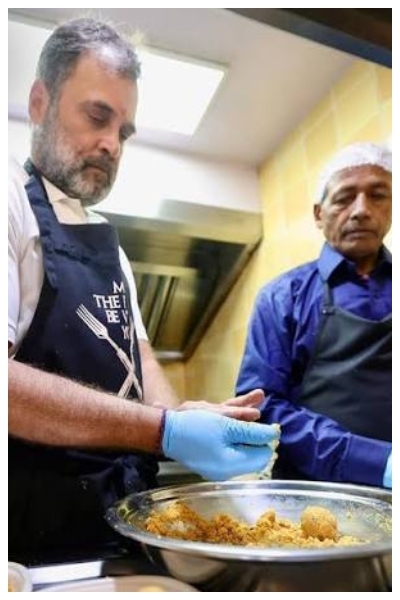
The citizen, fortunately, is less complicated. He may vote for one party and eat food preferred by another. He may admire one leader and disagree with him at dinner. He may be religious, secular, vegetarian, non-vegetarian, conservative, liberal or simply hungry. The Constitution does not require ideological consistency at the dining table. And that may be the real difficulty. Politics wants everything to become a political statement.
A meal must become an identity. A festival must become an ideology. A preference must become a manifesto. A disagreement must become a campaign.
ALSO READ: The Veto Must Go: An Imperial Relic in a Changed World
There is another small irony here. When India's international engagement produces something politically uncomfortable, one would expect the Opposition to ask harder questions about trade, diplomacy, jobs, investment, strategic autonomy or the country's role in a changing world. Those would be legitimate political questions. Instead, we appear to be entering the era of culinary geopolitics.
BRICS can deal with the global order. Rahul Gandhi can deal with the global menu. Perhaps this is the division of labour. But there is one consolation for everybody involved. India's voters are unlikely to surrender their kitchens to politics. They have survived governments, ideologies, economic crises, television debates and election manifestos. They will probably survive political advice about dinner too. And if Rahul Gandhi is genuinely searching for an issue capable of matching the scale of India's international ambitions, the answer may not be found on somebody else's plate. There is a whole world outside the kitchen. It is called politics.