From Starvation Headlines to Diplomatic Gift Packs: How Koraput Coffee Became India's Stealth Revolution
Koraput-Bolangir-Kalahandi wasn’t a geographic marker; it was a code for shameful state failure. Starvation deaths, distress migration to brick kilns, and skeletal children on front pages defined the region.
Total Views |


The chatter at Bharat Mandapam echoed with the familiar cadences of multipolarity. Delegates debated supply chains, digital futures, and the shifting sands of global power. Yet in the official kits, between glossy brochures and ceremonial trinkets, sat a quiet insurgent: a 250-gram pack of "Tiger Bright" Koraput Coffee. This was no accident. It was a deliberate insertion of tribal Odisha into the rarefied air of international diplomacy.
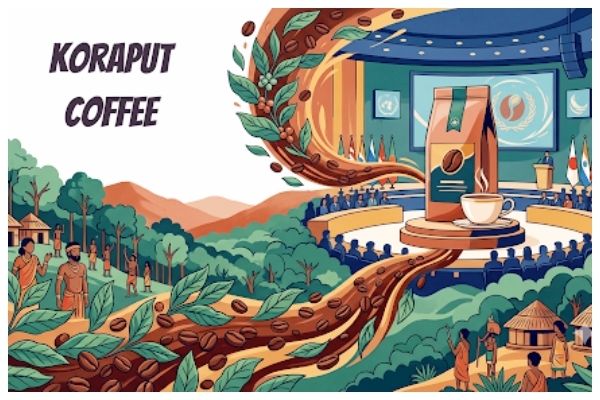 Now, step back for a moment and examine the map. Koraput, tucked into the forested eastern ghats of Odisha, grows its Arabica under a canopy of mango, citrus, and jackfruit trees. At 3,000 feet elevation, the shade-grown beans mature slowly, acquiring a complex acidity and depth. For decades, this was just another undervalued forest product in a region synonymous with neglect.
Remember what "KBK" meant in the 1980s and 1990s? Koraput-Bolangir-Kalahandi wasn’t a geographic marker; it was a code for shameful state failure. Starvation deaths, distress migration to brick kilns, and skeletal children on front pages defined the region. Governments in Bhubaneswar and Delhi alternated between hand-wringing and fleeting relief packages. The narrative was set: these were backward districts, condemned by geography and history to perpetual deprivation. The tribal communities were either anthropological curiosities or victims awaiting rescue.
The transformation in Koraput turns that narrative on its head. It began with recognizing what the forest always held: potential. The Tribal Development Co-operative Corporation of Odisha (TDCCOL) systematized cultivation and post-harvest processing. Prime Minister Modi’s Mann Ki Baat spotlight and the One District One Product (ODOP) framework provided crucial visibility and institutional backing. Today, over 6,400 tribal farmers tend 5,100 hectares of coffee. Each hectare can generate sustainable earnings between two and seven lakh rupees over decades. This isn’t charity; it’s commerce. It’s the tangible outcome of seeing Janjatiya communities not as beneficiaries of state patronage, but as capable economic agents.
The political shift in Bhubaneswar accelerated this change. Odisha’s first BJP Chief Minister, Mohan Charan Majhi, a tribal leader himself, embodies this ideological pivot. His government, alongside Deputy CM Pravati Parida, champions Koraput coffee not merely as a crop, but as a symbol of "Odisha First" and national pride. This is Purvodaya in action. Eastern India’s resources, long exploited or ignored, are finally translating into local wealth and self-respect. The emergence of a tribal leadership in sync with the Centre’s focus on enterprise over entitlement marks a fundamental realignment.
Consider the subtle power play here. For years, the KBK belt was part of the "Red Corridor," a laboratory for failed socialist experiments and Maoist insurgency. Decades of welfare schemes did little to alter the material conditions that fueled violence. Market integration, direct cash flow from high-value agriculture, and improved connectivity achieve what patronage could not: they drain the swamp of discontent. When a farmer in Pottangi or Nandapur earns premium prices for world-class coffee, the appeal of extremism withers.
The BRICS summit placement was the final masterstroke. In gifting Koraput coffee to global leaders, Modi’s India turned foreign policy into a direct marketing channel for its deepest grassroots. This is economic nationalism weaponized as soft power. It tells the world that India’s tribal heartland isn’t a problem to be managed, but a source of value to be celebrated. The message is clear: our forests produce treasures, our Janjatiya brothers and sisters are partners in prosperity, and our development model delivers where decades of talk failed.
Real decolonization isn’t just about changing street names. It’s about dismantling the mental architecture of backwardness. Koraput coffee, served at Bharat Mandapam, signals that India’s most marginalized regions are now active participants in the national story, not passive subjects of pity. The journey from starvation reports to specialty coffee in diplomatic gift hampers is the most compelling argument for a governance model that finally recognizes: self-reliance is the ultimate empowerment.
Remember what "KBK" meant in the 1980s and 1990s? Koraput-Bolangir-Kalahandi wasn’t a geographic marker; it was a code for shameful state failure. Starvation deaths, distress migration to brick kilns, and skeletal children on front pages defined the region. Governments in Bhubaneswar and Delhi alternated between hand-wringing and fleeting relief packages. The narrative was set: these were backward districts, condemned by geography and history to perpetual deprivation. The tribal communities were either anthropological curiosities or victims awaiting rescue.
The transformation in Koraput turns that narrative on its head. It began with recognizing what the forest always held: potential. The Tribal Development Co-operative Corporation of Odisha (TDCCOL) systematized cultivation and post-harvest processing. Prime Minister Modi’s Mann Ki Baat spotlight and the One District One Product (ODOP) framework provided crucial visibility and institutional backing. Today, over 6,400 tribal farmers tend 5,100 hectares of coffee. Each hectare can generate sustainable earnings between two and seven lakh rupees over decades. This isn’t charity; it’s commerce. It’s the tangible outcome of seeing Janjatiya communities not as beneficiaries of state patronage, but as capable economic agents.
ALSO READ: Why do well-off Indians still keep cribbing?
Consider the subtle power play here. For years, the KBK belt was part of the "Red Corridor," a laboratory for failed socialist experiments and Maoist insurgency. Decades of welfare schemes did little to alter the material conditions that fueled violence. Market integration, direct cash flow from high-value agriculture, and improved connectivity achieve what patronage could not: they drain the swamp of discontent. When a farmer in Pottangi or Nandapur earns premium prices for world-class coffee, the appeal of extremism withers.
ALSO READ: UCC: A Constitutional Mandate, Not a Political Choice
Real decolonization isn’t just about changing street names. It’s about dismantling the mental architecture of backwardness. Koraput coffee, served at Bharat Mandapam, signals that India’s most marginalized regions are now active participants in the national story, not passive subjects of pity. The journey from starvation reports to specialty coffee in diplomatic gift hampers is the most compelling argument for a governance model that finally recognizes: self-reliance is the ultimate empowerment.