Pakistan Heard Modi’s Message in Bishkek
NewsBharati 02-Sep-2026 13:19:32 PM
Total Views |


Prime Minister Narendra Modi has once again demonstrated that diplomacy does not necessarily require diplomatic ambiguity. At the Shanghai Cooperation Organisation (SCO) summit in Bishkek, he delivered a message on terrorism that was carefully worded, institutionally appropriate and yet impossible to misunderstand. Pakistan’s Prime Minister Shehbaz Sharif was sitting in the room.Modi did not name Pakistan. He did not need to.
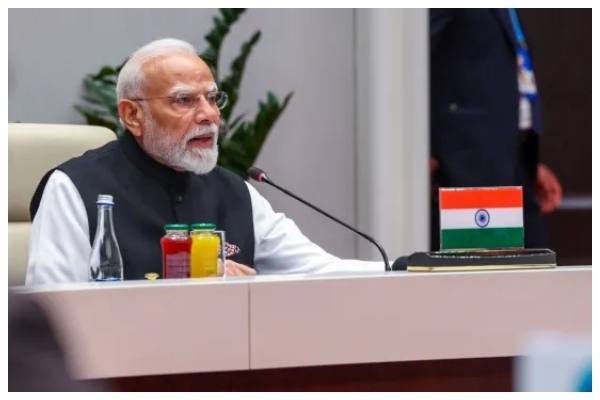 It was not merely another condemnation of terrorism. The world has heard thousands of such condemnations. Governments routinely issue statements after terrorist attacks, express condolences, and promise to fight extremism. But terrorism survives because somewhere between condemnation and action lies a dangerous space called political convenience.
Modi's intervention addressed precisely that problem. The most important phrase was perhaps “no double standards”. For decades, the international community has struggled with a basic contradiction - terrorism is condemned in principle but sometimes tolerated in practice when it serves geopolitical calculations. Terrorists are described as freedom fighters by one country, extremists by another and strategic assets by a third. Such ambiguity is precisely what allows terrorism to survive. And India has lived with the consequences.
Cross-border terrorism has not been an abstract security concern for India. It has claimed civilian lives, targeted security forces, attacked cities and attempted to destabilise society. India has repeatedly argued that terrorism cannot be separated from those, who finance it, train it, recruit for it, provide ideological support to it or offer terrorists sanctuary.The Bishkek speech placed that argument squarely before the wider SCO community. And the timing mattered.
Pakistan has assumed the SCO chairmanship. Its prime minister was present when Modi spoke. Therefore, the words “terrorism as a strategic asset” acquired an unmistakable diplomatic significance. This was not a shouting match across the border. It was something more effective - a principle placed on the international record.
 Terror financing must be stopped. Recruitment must be disrupted. Radicalisation must be confronted. Safe havens must disappear.And states that knowingly facilitate terrorism must face consequences. This is a much more comprehensive counter-terrorism doctrine than simply waiting for the next attack.
For Pakistan, this creates an uncomfortable question. If terrorism is not a strategic asset, why should any state tolerate organisations that attack another country while simultaneously presenting itself as a victim of terrorism? If terrorism is universally unacceptable, why should the identity of the victim or the political objective of the terrorist alter the international response?
And if terrorism is truly a threat to humanity, why should there be one standard for terrorism in Europe, another in West Asia and another in South Asia? These are not questions directed only at Pakistan. They are questions for the entire international system. India's position has increasingly become difficult to dismiss because it is grounded in experience.
The world has also changed. After the rise of global jihadist networks, the attacks of September 11, the Mumbai attacks and the continuing spread of extremist violence across regions, the old distinction between “good terrorists” and “bad terrorists” has become increasingly indefensible. A terrorist organisation does not become legitimate merely because somebody finds its political objective convenient.
There was another important dimension to Modi's Bishkek message.
He linked security with connectivity and opportunity. His vision for the SCO's next phase rests on the idea of transforming shared geography into shared opportunities, with security, connectivity and opportunity forming the three broad pillars.
That is significant. Central Asia, South Asia and the wider Eurasian region cannot realise their economic potential if terrorism continues to poison the security environment. Trade routes require stability. Investment requires confidence. Connectivity requires security.
Development requires peace. A country cannot simultaneously demand economic integration and provide political space to terrorism. The two objectives are fundamentally incompatible.
This is where Modi's argument acquires a larger regional significance. He is not presenting counter-terrorism as India's bilateral quarrel with Pakistan. He is presenting it as a prerequisite for the SCO's own economic and strategic future. That is precisely where Pakistan's position becomes increasingly difficult to sustain.
The era when terrorism could be treated as somebody else's problem must end. Bishkek Modi's Bishkek intervention therefore deserves to be read as part of a larger evolution in India's counter-terrorism diplomacy.
India is no longer merely asking the world to sympathise with its victims. It is asking the world to confront the architecture that produces those victims. That is a profound difference.
The message from Bishkek was simple- terrorism is not a legitimate instrument of foreign policy; terrorists cannot be strategic assets; and there can be no selective morality in fighting terror. For Pakistan, the message was unmistakable even without the word “Pakistan” being uttered. Modi's words in Bishkek were therefore not merely a warning to Pakistan. They were a challenge to the world's double standards.
And this time, the message was delivered with the intended recipient sitting right there.
He said there must be “no double standards” in the fight against terrorism and called for the dismantling of the entire terrorism ecosystem its financing, recruitment, radicalisation and safe havens. More significantly, he made the point that countries, which use terrorism as an instrument of state policy or provide shelter and support to terrorists, must be told clearly that terrorism cannot be a strategic asset.
That was the real message from Bishkek.
Modi's intervention addressed precisely that problem. The most important phrase was perhaps “no double standards”. For decades, the international community has struggled with a basic contradiction - terrorism is condemned in principle but sometimes tolerated in practice when it serves geopolitical calculations. Terrorists are described as freedom fighters by one country, extremists by another and strategic assets by a third. Such ambiguity is precisely what allows terrorism to survive. And India has lived with the consequences.
Cross-border terrorism has not been an abstract security concern for India. It has claimed civilian lives, targeted security forces, attacked cities and attempted to destabilise society. India has repeatedly argued that terrorism cannot be separated from those, who finance it, train it, recruit for it, provide ideological support to it or offer terrorists sanctuary.The Bishkek speech placed that argument squarely before the wider SCO community. And the timing mattered.
ALSO READ: Disha Salian Death Case: Bombay HC Orders CBI Investigation
Modi's formulation also goes beyond the conventional understanding of terrorism. A terrorist carrying a weapon is only the visible end of a much larger ecosystem. Behind terrorism can lie money, propaganda, recruitment networks, ideological indoctrination, logistical support, training infrastructure and safe havens. Destroying the individual terrorist while leaving that ecosystem intact is like cutting the branches of a poisonous tree while continuing to water its roots. That is why Modi's call to dismantle the entire ecosystem deserves attention.
For Pakistan, this creates an uncomfortable question. If terrorism is not a strategic asset, why should any state tolerate organisations that attack another country while simultaneously presenting itself as a victim of terrorism? If terrorism is universally unacceptable, why should the identity of the victim or the political objective of the terrorist alter the international response?
And if terrorism is truly a threat to humanity, why should there be one standard for terrorism in Europe, another in West Asia and another in South Asia? These are not questions directed only at Pakistan. They are questions for the entire international system. India's position has increasingly become difficult to dismiss because it is grounded in experience.
The world has also changed. After the rise of global jihadist networks, the attacks of September 11, the Mumbai attacks and the continuing spread of extremist violence across regions, the old distinction between “good terrorists” and “bad terrorists” has become increasingly indefensible. A terrorist organisation does not become legitimate merely because somebody finds its political objective convenient.
There was another important dimension to Modi's Bishkek message.
ALSO READ: “I Would Feel Like a Coward”: Swara Bhasker erupts controversy over Padmaavat’s Jauhar scene AGAIN
That is significant. Central Asia, South Asia and the wider Eurasian region cannot realise their economic potential if terrorism continues to poison the security environment. Trade routes require stability. Investment requires confidence. Connectivity requires security.
Development requires peace. A country cannot simultaneously demand economic integration and provide political space to terrorism. The two objectives are fundamentally incompatible.
This is where Modi's argument acquires a larger regional significance. He is not presenting counter-terrorism as India's bilateral quarrel with Pakistan. He is presenting it as a prerequisite for the SCO's own economic and strategic future. That is precisely where Pakistan's position becomes increasingly difficult to sustain.
The era when terrorism could be treated as somebody else's problem must end. Bishkek Modi's Bishkek intervention therefore deserves to be read as part of a larger evolution in India's counter-terrorism diplomacy.
India is no longer merely asking the world to sympathise with its victims. It is asking the world to confront the architecture that produces those victims. That is a profound difference.
The message from Bishkek was simple- terrorism is not a legitimate instrument of foreign policy; terrorists cannot be strategic assets; and there can be no selective morality in fighting terror. For Pakistan, the message was unmistakable even without the word “Pakistan” being uttered. Modi's words in Bishkek were therefore not merely a warning to Pakistan. They were a challenge to the world's double standards.
And this time, the message was delivered with the intended recipient sitting right there.

Editor's Desk
Editor's Desk