CNN said ‘Altercation’, BBC said ‘Fight’: How western media framed the Flydubai incident
They described it as an “altercation”, “fight”, “struggle” and even a “brawl” between two pilots. But the incident involved a stabbing, a rapid descent of nearly 14,000 feet and an attempt to crash an Israel-bound aircraft.
Total Views |


On September 30, 2026, flydubai flight FZ1073 departed Dubai for Tel Aviv carrying 174 people, most of them Israeli passengers.
While the aircraft was over north-western Saudi Arabia, it experienced a sudden and dramatic descent. Flight-tracking data showed the aircraft transmitting emergency signals, including squawk 7500, the internationally recognised transponder code associated with unlawful interference or hijacking. Flight-tracking data also showed 7700 emergency signals.
The aircraft subsequently diverted to Tabuk in Saudi Arabia, where the two pilots were taken to hospital.
It was reported that the jet plunged nearly 14,000 feet in less than 30 seconds after the cockpit incident began. Passengers and crew subsequently entered the cockpit and overpowered the co-pilot, allowing other pilots travelling on the aircraft to take control and land the plane.
Israeli Prime Minister Benjamin Netanyahu later compared the potential consequences to the September 11 attacks, saying the captain's actions had prevented what he described as a possible “9/11 style attack”. Had the attempt to seize control of the aircraft and crash it not been stopped, the consequences could have been catastrophic, given that the aircraft was carrying 174 people, most of them Israeli passengers.
All 174 passengers eventually reached Israel safely on a replacement aircraft.
What Israeli officials said happened
Israeli Prime Minister Benjamin Netanyahu said the co-pilot stabbed Captain Smit Machchhar and attempted to crash the aircraft in order to kill all the passengers boarding the aircraft.
According to Netanyahu's account, Machchhar fought back despite his injuries and managed to open the cockpit door. Passengers and crew then entered and overpowered the attacker.
Netanyahu said Machchhar's actions helped save the lives of 174 people. Indian Prime Minister Narendra Modi also praised the Indian pilot for his courage.
Israeli Defence Minister Israel Katz described the incident as an attempted jihadist terror attack.
How western media reported the incident
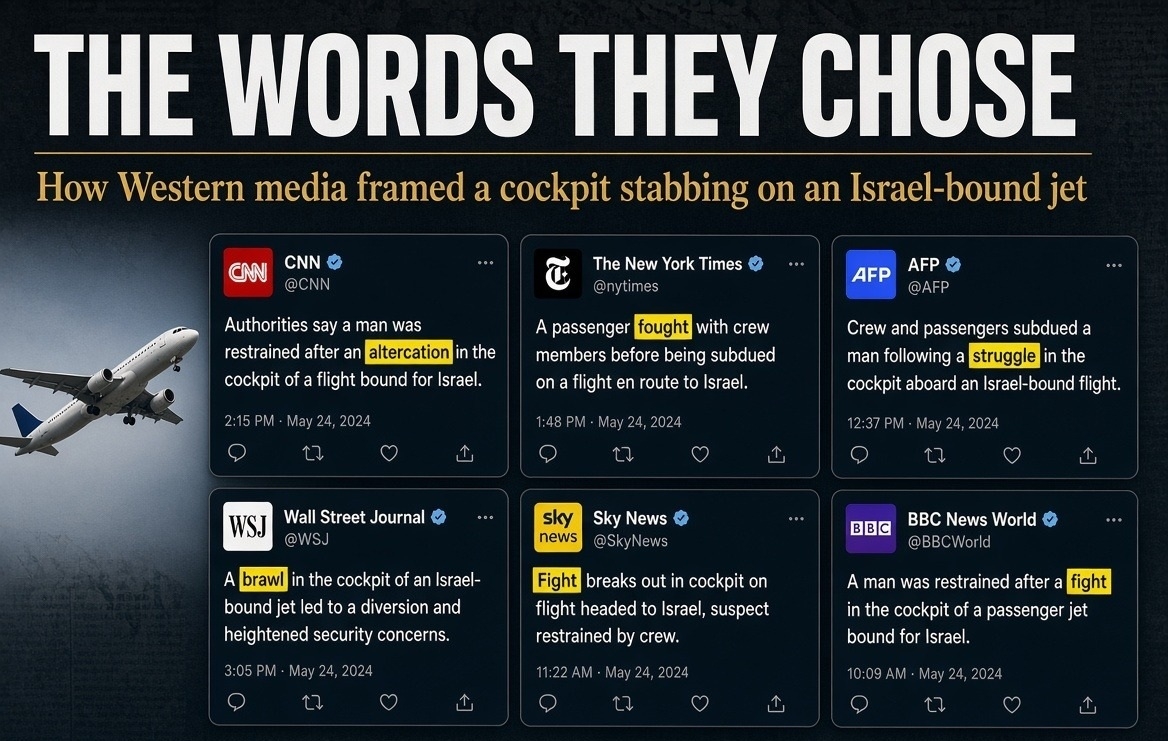
Soon after the attack, reports regarding it started coming up. As usual the propagandas also started to float. The flagbearers among this propaganda coverage of the incident remained the western media outlets. They had called the incident an “altercation” and a “brawl” among many generalised terms but not a terror attack on innocent civilians.
CNN, The New York Times, AFP, The Wall Street Journal, Sky News, BBC, UPI, USA Today, Reuters and AP and others were peddling information around the incident which did not match the official communication. Their early headlines and social posts became the first version of the story consumed by millions of readers.
Instead of leading with the reported stabbing of the captain, the aircraft's dramatic descent, the 7500 hijack code, the attempt to take control of the aircraft or the fact that 174 people were aboard an Israel-bound flight, several outlets initially reduced the incident to a “fight,” “altercation,” “struggle” or “brawl” between two pilots.
The choice of noun matters because it determines what the reader understands before reaching the details.
CNN: “Violent Altercation”
CNN described the incident as a “violent” altercation between two pilots that forced a Flydubai aircraft travelling from Dubai to Tel Aviv to divert to Saudi Arabia.
The word “violent” acknowledged that something serious had happened, but “altercation” still framed the incident as a confrontation between two individuals. The wording did not tell the reader that the captain had allegedly been stabbed, that the aircraft had undergone a dramatic descent or that passengers would later enter the cockpit and overpower the other pilot.
The structure also created a degree of symmetry: two pilots involved in an altercation.
That is materially different from saying that one pilot allegedly attacked another while the aircraft was in flight.
ALSO READ : Exposing hypocrisy of the opposition: The double standards over election officials — An Explainer
The New York Times: “Altercation”
The New York Times' breaking-news wording was similarly restrained: a plane flying from Dubai to Israel had been diverted after an “altercation” between the pilot and co-pilot, according to Israeli officials.
Again, the central noun was “altercation”.
The early wording did not mention a stabbing, an alleged attempt to crash the aircraft or the extraordinary descent that was subsequently reported. The reader was presented primarily with a dispute involving two members of the flight crew.
The result was a headline that described the immediate disruption but gave little indication of the potentially catastrophic circumstances inside the cockpit.
AFP: “Fought”
AFP described the two pilots as having reportedly “fought” on board the aircraft, leaving both wounded and forcing an emergency landing in Saudi Arabia.
The wording placed the emphasis on a physical confrontation rather than identifying an alleged attacker and victim.
“Fought” also carries an inherently reciprocal meaning. It tells the reader that two people were involved in physical violence, but does not establish who initiated it, whether a weapon was involved or what was allegedly happening to the aircraft itself.
The aircraft's destination was mentioned. The larger context surrounding the passengers and the reported events inside the cockpit was not part of the initial framing.
The Wall Street Journal: “Struggle”
The Wall Street Journal described the incident as an apparent “struggle in the cockpit” that left both pilots injured and forced the Israel-bound aircraft to make an emergency landing.
“Struggle” is another word that does not establish an aggressor.
The phrase “both pilots injured” was factually consistent with the reported injuries, but it also placed the two men on broadly equal footing in the headline.
Later accounts described a different sequence: the captain was allegedly stabbed, the aircraft rapidly descended, and passengers and crew intervened after the cockpit door was opened.
The first description, however, was a “struggle”.
Sky News: “Brawl”
Sky News used the most colloquial description among the major outlets, reporting that the flight landed safely after a “brawl” between pilots.
The word “brawl” evokes a chaotic physical confrontation rather than an alleged attack inside the cockpit of a passenger aircraft.
The accompanying emphasis on the aircraft landing “safely” also shifted attention towards the outcome rather than the danger reportedly faced during the flight.
The later details including the rapid descent, emergency transponder codes and the intervention of passengers, presented a considerably more serious picture of what had occurred before the aircraft reached the ground.
BBC News: “Fight Between Pilots”
BBC News' early World headline reduced the incident to an “Israel-bound flight diverted after fight between pilots.”
The formulation is remarkably compact.
The aircraft's destination is there. The diversion is there. The alleged confrontation is there.
But the alleged stabbing is absent. The rapid descent is absent. The alleged attempt to crash the aircraft is absent. The fact that passengers and crew eventually intervened is absent.
The central description is simply “fight between pilots.”
BBC subsequently published fuller reporting as more information became available, including details about the stabbing and Captain Smit Machchhar. But the initial headline had already supplied the first frame to audiences following the breaking story.
UPI: “Physical Altercation”
UPI used the phrase “physical altercation in cockpit”, saying it forced the FlyDubai flight to divert.
The word “physical” indicated that the incident was more than a verbal dispute. Yet the headline still stopped short of describing the specific act later reported by officials and passengers.
The focus remained on the consequence, the diversion, rather than the alleged violence that triggered it.
USA Today: “Physical Altercation”
USA Today, using early Reuters reporting, also described the incident as a “physical altercation” between the pilots.
Again, the formulation presented the event as a confrontation rather than an alleged attack.
Later Reuters reporting was considerably more explicit, describing allegations that the co-pilot stabbed the captain and attempted to crash the aircraft.
This progression is important because it shows how the description changed as more information became available. The early version that travelled through news alerts was substantially less specific than the later account.
AP: “Fight Between Pilots”
The Associated Press' early live coverage similarly used “fight between pilots” as its top-line description.
What makes the AP coverage particularly notable is the contrast within the developing report itself. While the headline language described a fight, material lower in the live file included Israeli Prime Minister Benjamin Netanyahu's account that the captain had been stabbed and that there had apparently been an attempt to crash the aircraft.
In other words, the more serious account was already present in the reporting while the headline continued to foreground the simpler description of a fight.
For readers who saw only the alert or headline, the event could therefore appear to be a dispute between two pilots rather than a potentially catastrophic cockpit attack.
Flydubai: “Altercation”
Flydubai itself described the incident as an “altercation” in the flight deck and said that crew members travelling on the flight secured the aircraft.
For an airline dealing with a developing incident involving its own crew, such cautious corporate language is unsurprising. The airline had an ongoing investigation and a responsibility to communicate about an unfolding emergency.
The more important question is what happened when that corporate terminology entered the wider news cycle.
Several major outlets adopted the same basic noun in their initial reporting, even as officials and passengers were providing additional details about what had allegedly occurred inside the cockpit.