Country of Origin Filter: India has notified the right reform; now it must not wait till 2027
NewsBharati 10-Jun-2026 15:58:44 PM
Total Views |


India’s February 2026 amendment to the Legal Metrology (Packaged Commodities) Rules was a meaningful step for consumer rights. It required e-commerce platforms selling imported products to offer searchable and sortable Country of Origin filters. That momentum should not now be lost to delay.
The distinction worth underscoring is between disclosure and discoverability. Burying Country of Origin in a product field technically satisfies transparency; surfacing it through a filter actually enables it. Consumers may make different choices for different reasons, but they deserve the practical ability to make an informed choice, not just the theoretical one
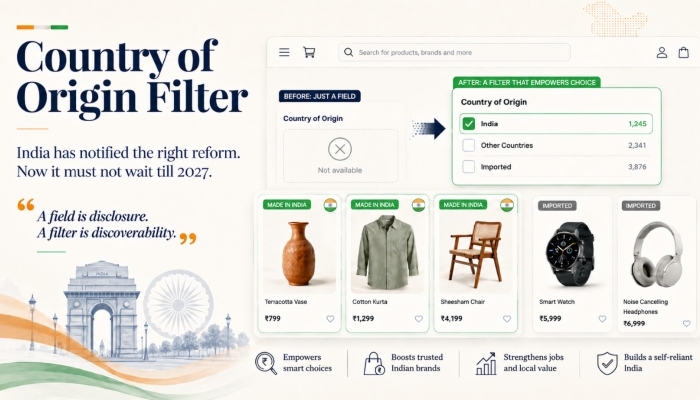
The Country of Origin filter is neither protectionist nor prescriptive; it is a straightforward, practical tool that places informed choice within reach of every online shopper. It does not restrict imports or steer consumer behaviour; it simply ensures that the decision to buy domestic or foreign is made with full awareness rather than by default. In a digital marketplace that serves close to 300 million shoppers, the scale alone makes the case. Transparency at that reach is not a courtesy extended to consumers; it is a baseline obligation. Whether a shopper's preference is to back Indian producers, seek out a specific import, or simply know what they are buying, the filter accommodates all of it without imposing any of it. That is what makes this reform both democratic and uncontroversial in principle: it expands choice rather than constraining it.
The Citizen-led journey from field to filter
The logic was simple: if consumers have the right to know the price, quantity, seller details and other product information, they should also be able to know the country where the product was manufactured. That intervention helped bring public and policy attention to a major gap in India’s online marketplace. The Country of Origin field was subsequently added to e-commerce listings, giving Indian consumers at least a basic level of origin-related information while shopping online.
But Rao did not stop at the field. She continued to press for the next logical step: not merely display, but searchability and sortability through a Country of Origin filter. She argued that if the consumer has to click on ten, twenty, or fifty products to identify which ones are made in India, the system does not truly empower choice. For Country of Origin information to become meaningful, it must be searchable and sortable.
In that sense, the February 2026 notification was not merely a bureaucratic amendment. It was the result of a sustained citizen-led effort whose roots go back to 2020: first, to get the Country of Origin field added; next, to get that information made usable through a filter. The notified rule was therefore a major step in the right direction. The question is: why should Indian consumers now wait another year for a right whose logic has already been accepted?
Why a field is not enough
_202606101545588575_H@@IGHT_400_W@@IDTH_700.jpg "Country of Origin Filter")
For such a country, consumer information must be simple, visible and actionable. A Country of Origin filter gives a direct route to a direct question: where was this product made? In India, access is not only about availability. Access is also about ease. A right that is too difficult to exercise becomes weak in practice.
Prime Minister Narendra Modi’s call for Vocal for Local is rooted in strengthening local manufacturing, employment and economic self-reliance. But citizens can support Indian-made products only if they can easily identify them. The Country of Origin filter bridges this gap by turning intent into action at the point of purchase. It does not force consumer choices; it enables informed ones. If Vocal for Local is to become mass economic behaviour, India needs visibility tools: a Country of Origin filter online and a national Made in India symbol across the wider marketplace.
Why the delay matters
_202606101547454988_H@@IGHT_400_W@@IDTH_700.jpg "Country of Origin Filter")
E-commerce platforms already capture Country of Origin as a product field. The reform simply makes that information filterable, no different in principle from existing filters for price, brand or rating. This is not a technological burden; it is a configuration choice. The compliance obligation falls where mixed-origin catalogues create consumer confusion. Domestic-only sellers are unaffected.
The Government has notified the right rule. Delaying implementation until 2027 weakens a reform whose benefits are needed now. The Country of Origin filter should not wait.
The distinction worth underscoring is between disclosure and discoverability. Burying Country of Origin in a product field technically satisfies transparency; surfacing it through a filter actually enables it. Consumers may make different choices for different reasons, but they deserve the practical ability to make an informed choice, not just the theoretical one
Pushing implementation to July 2027 doesn't merely defer a procedural requirement; it defers a benefit that consumers, Indian producers and the national economy could be receiving today. Reforms of this kind lose credibility the longer they sit between enactment and enforcement.
The Country of Origin filter is neither protectionist nor prescriptive; it is a straightforward, practical tool that places informed choice within reach of every online shopper. It does not restrict imports or steer consumer behaviour; it simply ensures that the decision to buy domestic or foreign is made with full awareness rather than by default. In a digital marketplace that serves close to 300 million shoppers, the scale alone makes the case. Transparency at that reach is not a courtesy extended to consumers; it is a baseline obligation. Whether a shopper's preference is to back Indian producers, seek out a specific import, or simply know what they are buying, the filter accommodates all of it without imposing any of it. That is what makes this reform both democratic and uncontroversial in principle: it expands choice rather than constraining it.
The Citizen-led journey from field to filter
The Country of Origin issue did not emerge in a vacuum. In 2020, during a period of heightened national concern over imports, supply chains and economic self-reliance, Mumbai-based author and nation-building activist Savitha Rao took up the issue of Country of Origin disclosure in online shopping. Rao, founder of the India Positive Citizen initiative and later initiator of One Nation One Symbol for Made in India, worked to make the Country of Origin field mandatory in e-commerce listings. She wrote to key arms of the Government, including the Prime Minister’s Office, the Commerce Ministry and the MSME Ministry, urging that consumers should be able to know where a product was made.
The logic was simple: if consumers have the right to know the price, quantity, seller details and other product information, they should also be able to know the country where the product was manufactured. That intervention helped bring public and policy attention to a major gap in India’s online marketplace. The Country of Origin field was subsequently added to e-commerce listings, giving Indian consumers at least a basic level of origin-related information while shopping online.
But Rao did not stop at the field. She continued to press for the next logical step: not merely display, but searchability and sortability through a Country of Origin filter. She argued that if the consumer has to click on ten, twenty, or fifty products to identify which ones are made in India, the system does not truly empower choice. For Country of Origin information to become meaningful, it must be searchable and sortable.
In that sense, the February 2026 notification was not merely a bureaucratic amendment. It was the result of a sustained citizen-led effort whose roots go back to 2020: first, to get the Country of Origin field added; next, to get that information made usable through a filter. The notified rule was therefore a major step in the right direction. The question is: why should Indian consumers now wait another year for a right whose logic has already been accepted?
Why a field is not enough
For the average citizen, shopping online is not a research project. A mother buying school supplies, a small shopkeeper buying tools, a student buying electronics accessories, a homemaker buying kitchen products, or a senior citizen buying health equipment may not have the time or patience to open dozens of listings to compare origin details. A filter reduces friction. It turns intention into action. It allows a consumer to say, “Show me Indian-made options first,” or “Let me compare by country of origin,” or “Let me support domestic alternatives where available.”
This matters even more in India. India is not a small, uniform market. It is a vast marketplace of many languages, income levels, education levels, geographies and shopping behaviours. Crores of Indians shop online or are influenced by online shopping patterns. Many are not deeply familiar with import labels, product classification, technical terminology or digital fine print. Many may not be comfortable navigating long product descriptions in English.
For such a country, consumer information must be simple, visible and actionable. A Country of Origin filter gives a direct route to a direct question: where was this product made? In India, access is not only about availability. Access is also about ease. A right that is too difficult to exercise becomes weak in practice.
Prime Minister Narendra Modi’s call for Vocal for Local is rooted in strengthening local manufacturing, employment and economic self-reliance. But citizens can support Indian-made products only if they can easily identify them. The Country of Origin filter bridges this gap by turning intent into action at the point of purchase. It does not force consumer choices; it enables informed ones. If Vocal for Local is to become mass economic behaviour, India needs visibility tools: a Country of Origin filter online and a national Made in India symbol across the wider marketplace.
Why the delay matters
The implementation of the Country of Origin filter has reportedly been deferred to 1 July 2027, despite the original 1 July 2026 deadline already providing a substantial compliance window. The issue is not additional time for platforms, but another year of lost transparency for consumers. During that period, crores of online purchases will occur daily without an easy way to identify Indian-made products. The cost of delay is behavioural: consumers gain the right in principle, but not the practical tool. The reform has been notified; it now requires timely execution.
E-commerce platforms already capture Country of Origin as a product field. The reform simply makes that information filterable, no different in principle from existing filters for price, brand or rating. This is not a technological burden; it is a configuration choice. The compliance obligation falls where mixed-origin catalogues create consumer confusion. Domestic-only sellers are unaffected.
The Government has notified the right rule. Delaying implementation until 2027 weakens a reform whose benefits are needed now. The Country of Origin filter should not wait.

Siddhi Somani
Siddhi Somani is known for her satirical and factual hand in Economic, Social and Political writing. Having completed her post graduation in Journalism, she is currently engaged in completing her Masters in Politics. The author meanwhile is also exploring her hand in analytics and statistics.