Press Freedom in India needs a view beyond international rankings
This reality raises an important question. If there were no press freedom in India, how would these organisations be able to consistently express their views, publish critical reporting, and engage in public debate?
Total Views |


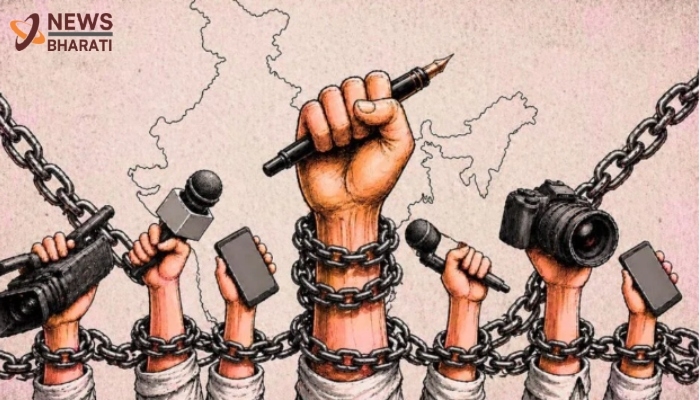
The recent press freedom rankings published by Reporters Without Borders (RSF) have once again sparked debate about the state of media freedom in India. According to the report, India was ranked 157th in the world and slipped several places compared to the previous assessment. Such rankings often attract significant attention and are widely cited by political commentators, activists, and media observers. However, it is equally important to examine the realities of India's media environment before concluding the condition of press freedom in the country.
_202606121101569013_H@@IGHT_400_W@@IDTH_700.jpg "World Press Freedom")
One of the strongest facts highlighting the existence of press freedom in India is the ability of journalists and media organisations to criticise governments openly. Criticism of those in power is a fundamental feature of a free press. In India, media outlets routinely scrutinise government policies, question official decisions, investigate controversies, and publish reports that challenge the ruling establishment.
_202606121112416219_H@@IGHT_330_W@@IDTH_700.jpg "World Press Freedom")

_202606121131037812_H@@IGHT_457_W@@IDTH_700.jpg "World Press Freedom")
This reality raises an important question. If there were no press freedom in India, how would these organisations be able to consistently express their views, publish critical reporting, and engage in public debate? The continued existence of media outlets that openly challenge the government demonstrates that space for criticism and dissent remains present within India's democratic framework.
Historical context is also important when discussing press freedom. India's experience during the Emergency of 1975–1977 provides a useful point of comparison. During that period, press censorship was formally imposed. Newspapers faced direct restrictions, publications were subject to government control, and journalists operated under significant limitations. The Emergency remains one of the most widely discussed examples of state-imposed restrictions on media freedom in independent India.
Another factor often overlooked in international assessments is the sheer scale and diversity of Indian media. Unlike many countries with relatively small media markets, India possesses a vast network of publications and broadcasters operating across numerous regions and languages. National newspapers coexist with regional newspapers. Large television networks compete with local channels. Established publications operate alongside independent digital platforms. Citizens have access to information from a wide variety of sources, allowing them to compare perspectives and form their own opinions.
International rankings can provide useful perspectives and encourage discussion about media conditions. However, rankings are ultimately based on particular methodologies and assumptions. Different observers may interpret the same facts differently. Therefore, while such reports should be examined seriously, they should not be treated as the sole measure of press freedom in a country as large and complex as India.
In conclusion, debates about press freedom in India are likely to continue, especially when international organisations release new assessments. Yet any evaluation must take into account the country's unique democratic context and its extraordinarily diverse media ecosystem. The continued presence of media organisations that openly criticise the government, the absence of formal censorship comparable to the Emergency era, and the vast range of newspapers, television channels, and digital platforms available to the public suggest that India's media environment cannot be understood through rankings alone. International assessments often fail to fully account for the scale and diversity of India's media network, which includes thousands of newspapers, television broadcasters, and digital platforms operating across numerous languages and serving one of the world's largest and most vibrant democratic audiences.
India is the world's largest democracy, home to more than 1.4 billion people, hundreds of languages, and one of the most diverse media ecosystems. Every day, thousands of newspapers, television channels, websites, podcasts, and social media platforms carry opinions and reports representing a wide range of political perspectives. The existence of this vast and often highly critical media landscape suggests that the question of press freedom in India is far more complex than what a single numerical ranking may indicate.
One of the strongest facts highlighting the existence of press freedom in India is the ability of journalists and media organisations to criticise governments openly. Criticism of those in power is a fundamental feature of a free press. In India, media outlets routinely scrutinise government policies, question official decisions, investigate controversies, and publish reports that challenge the ruling establishment.
Several well-known media organisations continue to publish stories and commentary that are critical of the current government. Platforms such as Alt News, News Laundry, The Wire, and The Indian Express, etc regularly publish reports, investigations, opinion pieces, and analyses that question government actions and policies. Their articles are widely available to the public and are often shared extensively across digital platforms.
Recently on 20th April Alt News, led by Mohammed Zubair produced a report in which he directly accused PM Modi of misleading the nation over women's reservation bill. He also stated that the Indian media other than the one owned by him misrepresents the facts.
The Wire, on June 11, published a story claiming that the West Bengal government was deliberately targeting the Muslim community in the state, when the fact is that the illegal Bangladeshi immigrants in the state are being taken action against.
The Newslaundry recently published a report in which is directly discredited Yogi government's 2023 Global Investors Summit, which resulted in 19,250 MoUs being signed, with proposed investments worth Rs 33.52 lakh crore. The report raised questions on the entire initiative after one of its signatories, Obdu Digital Health Care Private Limited, faced an FIR, which is still under investigation. One of 19250 and the other 19249 MoUs; also, the entire summit gets discredited easily.
This reality raises an important question. If there were no press freedom in India, how would these organisations be able to consistently express their views, publish critical reporting, and engage in public debate? The continued existence of media outlets that openly challenge the government demonstrates that space for criticism and dissent remains present within India's democratic framework.
Historical context is also important when discussing press freedom. India's experience during the Emergency of 1975–1977 provides a useful point of comparison. During that period, press censorship was formally imposed. Newspapers faced direct restrictions, publications were subject to government control, and journalists operated under significant limitations. The Emergency remains one of the most widely discussed examples of state-imposed restrictions on media freedom in independent India.
The present situation differs significantly from that period. There is no officially declared press censorship regime comparable to the Emergency. Newspapers continue to publish daily editions containing diverse viewpoints. Television debates frequently feature critics of the government. Digital media platforms host a wide range of opinions, including those sharply opposed to ruling authorities. Political leaders, activists, academics, and journalists regularly express disagreement with government policies through newspapers, television programmes, websites, and social media channels.
This does not mean that India's media landscape is free from challenges. Like many democracies, India faces debates regarding media ownership, journalistic standards, misinformation, online harassment, and legal disputes involving journalists and media organisations. These concerns deserve discussion and scrutiny. However, the existence of challenges does not automatically establish the absence of press freedom. Democracies across the world continue to grapple with similar issues while maintaining vibrant and competitive media sectors.
Another factor often overlooked in international assessments is the sheer scale and diversity of Indian media. Unlike many countries with relatively small media markets, India possesses a vast network of publications and broadcasters operating across numerous regions and languages. National newspapers coexist with regional newspapers. Large television networks compete with local channels. Established publications operate alongside independent digital platforms. Citizens have access to information from a wide variety of sources, allowing them to compare perspectives and form their own opinions.
The rise of digital media has further expanded opportunities for expression. Online news portals, independent journalists, content creators, and citizen commentators regularly contribute to public discourse. Social media platforms provide additional avenues for debate and criticism. Government decisions are often discussed, analysed, supported, and opposed in real time by millions of users. Such widespread participation in public discussion reflects a media environment that remains active and highly engaged. It is also worth noting that disagreement with government policies is visible not only in specialised publications but also in mainstream public debate. Election campaigns, parliamentary discussions, television interviews, public forums, and opinion columns frequently feature competing viewpoints. This ongoing contest of ideas is an important characteristic of democratic societies.

International rankings can provide useful perspectives and encourage discussion about media conditions. However, rankings are ultimately based on particular methodologies and assumptions. Different observers may interpret the same facts differently. Therefore, while such reports should be examined seriously, they should not be treated as the sole measure of press freedom in a country as large and complex as India.
A balanced assessment requires looking beyond numerical positions on global indexes and considering the practical realities of everyday media activity. The ability of journalists to investigate issues, the existence of publications critical of the government, the diversity of viewpoints available to citizens, and the continued operation of thousands of media outlets all form part of the broader picture.
In conclusion, debates about press freedom in India are likely to continue, especially when international organisations release new assessments. Yet any evaluation must take into account the country's unique democratic context and its extraordinarily diverse media ecosystem. The continued presence of media organisations that openly criticise the government, the absence of formal censorship comparable to the Emergency era, and the vast range of newspapers, television channels, and digital platforms available to the public suggest that India's media environment cannot be understood through rankings alone. International assessments often fail to fully account for the scale and diversity of India's media network, which includes thousands of newspapers, television broadcasters, and digital platforms operating across numerous languages and serving one of the world's largest and most vibrant democratic audiences.