Proven politics of Change: 24 historic decisions BJP would prioritize after forming a government in Bengal
(BJP) Chief Minister Suvendu Adhikari"s administration wasted no time, implementing 24 significant policy decisions within its first week, an unprecedented pace of governance.


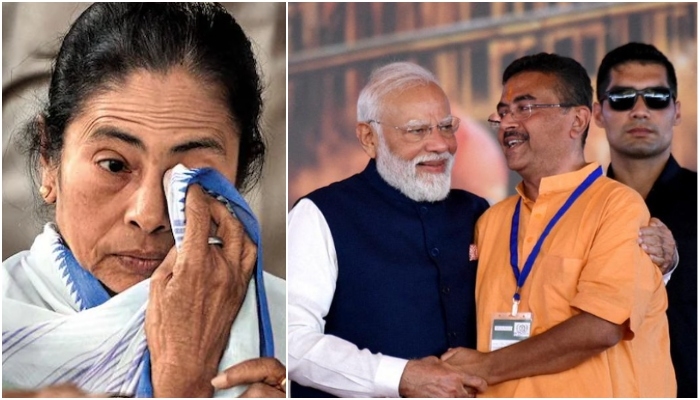
For years, concerns were raised that inadequate border management and political considerations enabled illegal cross-border infiltration in parts of West Bengal, contributing to demographic and security challenges. The new administration has announced a series of measures aimed at strengthening border security and improving coordination among enforcement agencies.
1. The government recently directed that all pending land transfers required for border fencing be completed within a strict 45-day timeframe, to remove administrative bottlenecks and expedite the completion of the India–Bangladesh border fence.
West Bengal Govt’s Special focus on crime control and curb infiltration in border districts.
— Keya Ghosh (@keyakahe) May 13, 2026
West Bengal Police has directed regular Border Coordination Meetings to strengthen surveillance, intelligence-sharing and crime control in border areas. Detailed instructions were issued… pic.twitter.com/oEopiaaf4j
3. Emphasizing a tougher approach toward internal security challenges, the Kolkata Police Special Task Force (STF) conducted an operation that led to the arrest of alleged Maoist Regional Committee member Sharadha Biswas from Kashipur, highlighting ongoing efforts to counter extremist networks and maintain law and order.
The previous administration under the TMC rule allowed informal patronage networks, "cut-money" practices, extortion, and the undue influence of criminal elements over public resources and economic activities. The new BJP government, after coming to power, pledged a comprehensive crackdown on corruption and organized criminal networks, positioning institutional transparency, accountability, and the rule of law as key priorities of its governance agenda.
4. The state government has approved pending requests for investigations and prosecutions by the Central Bureau of Investigation in connection with alleged corruption cases, including the Teachers’ Recruitment Scam, Municipal Recruitment Scam, and Cooperative Sector Scam, signaling a commitment to greater accountability and transparency.
6. Authorities have initiated legal proceedings against several high-profile political and bureaucratic figures accused of wrongdoing, emphasizing that investigations and law enforcement actions will proceed irrespective of an individual's position or influence. Most of these leaders have been found associated with the TMC. The list includes:
b. Shantanu Sinha Biswas (Kolkata Police DC)- arrested on serious charges of land grabbing, extortion syndicates, and money laundering tied to the notorious criminal Sona Pappu network. His services were immediately terminated following exposure of his links to hawala transactions and illicit sand trafficking.
c. Kaushik Ghosh and Mahesh Chandra Saha- arrested for running extensive cash-for-jobs rackets that destroyed the futures of lakhs of eligible youth.
d. TMC leaders Rafiqul Islam and Inayat Tulla Mandal- arrested and taken into custody on long-pending, suppressed charges of open murder and heavy narcotics trafficking.
e. Priyadarshini Mullick- summarily removed from her influential post as Secretary of the West Bengal Council of Higher Secondary Education as part of a sweeping institutional cleanup.
g. Immediate police action was taken against TMC MLA Dilip Mondal following his public, threatening remarks against opposition supporters.
h. In Murshidabad and Katwa, key criminal elements, including TMC Councillor Suphal Rajwar, who led a mob that pelted stones at Railway Protection Force (RPF) personnel, were tracked down and arrested.
7. The politicization of law enforcement and the perceived emergence of a privileged political class had weakened public confidence in the impartial application of the law. The Adhikari administration, after coming to power, introduced a series of measures aimed at reinforcing institutional accountability and ensuring that state resources are used in accordance with established norms.
8. Security provisions for political leaders have been reassessed based on standardized threat-evaluation criteria. As part of this process, the enhanced security cover previously provided to TMC leader Abhishek Banerjee was revised and aligned with the protection norms applicable to Members of Parliament.
In supersession of all previous orders and practices, the Government of West Bengal has mandated the singing of National Song of Bharat - Vande Mataram, during School Assembly Prayers before commencement of Classes in all Schools under the School Education Department across West… pic.twitter.com/QmQHoFqUfj
— Suvendu Adhikari (@SuvenduWB) May 14, 2026
The West Bengal government has issued a modified notice for the public under the West Bengal Animal Slaughter Control Act 1950, saying no cattle or buffalo can be slaughtered without official certification, which declares the animal fit for slaughter. No open public slaughter… pic.twitter.com/cBdYrdRkvW
— ANI (@ANI) May 14, 2026
14. Shifting from welfare models centered on periodic subsidies and intermediary-driven distribution, the government has emphasized direct benefit transfers, expanded social security coverage, and the streamlined implementation of welfare schemes through transparent delivery mechanisms. The government announced a new women's welfare initiative under which eligible women will receive Rs 3,000 per month through direct transfers to their bank accounts. The scheme commenced on June 1, 2026.
15. Beginning June 1, 2026, women across West Bengal are entitled to free travel on state-operated buses and public transport services, to improve mobility and reduce transportation costs. Old Age, Widow, and Disability Pensions have been increased from Rs 1,000 to Rs 2,000 per month, effective June 1, 2026, providing additional financial support to vulnerable sections of society.
17. The government has further moved to expand access to major centrally sponsored programs, including Ayushman Bharat, PM Shri Schools, PM Fasal Bima Yojana, PM Vishwakarma, Ujjwala Yojana, and Beti Bachao Beti Padhao. Authorities have stated that beneficiary verification mechanisms will be strengthened to ensure that welfare benefits reach eligible recipients in accordance with applicable laws and regulations.
18. The government has issued notifications removing regulatory barriers and dismantling checkposts that previously restricted the interstate movement of key agricultural commodities, including potatoes, food grains, and vegetables. The stated objective is to provide farmers with greater market access and the freedom to sell their produce across India without unnecessary administrative hurdles.
19. Restrictions on potato exports have been withdrawn as part of a broader effort to expand market opportunities for farmers and traders. The administration has also initiated consultations with cold-storage operators, agricultural traders, and other stakeholders to address supply-chain challenges, improve storage and distribution infrastructure, and strengthen the agricultural value chain.

21. Further, directives have been issued to permanently disconnect water and electricity connections to all illegal factories and unauthorized commercial complexes operating without environmental or municipal clearances.
22. Administrative Discipline: Government staff must now log in via biometric systems by 10:15 am and cannot leave before 5:15 pm, completely eradicating the culture of absenteeism. West Bengal cadre IAS and IPS officers will now regularly participate in the Central Government’s core training and capacity-building programs, ending the isolationist stance of the past.
23. The State ordered the immediate clearance of all logistical bottlenecks to ensure the flawless, ground-level implementation of the Bharatiya Nyaya Sanhita (BNS) across every police station in the State.
The pace and breadth of these 24 decisions are evidence that determined governance and administrative focus can drive significant policy changes within a short period of time. The reforms undertaken during the first week reflect a governance philosophy centered on decisive action, institutional accountability, national security, economic development, and cultural preservation. The current government is clearly showcasing that strong political leadership, combined with efficient execution, is essential for addressing long-standing challenges and accelerating the state's development trajectory.
The administration has positioned its initiatives as part of a broader effort to combat corruption, strengthen law and order, improve welfare delivery, enhance border and internal security, and ensure that public institutions function in accordance with constitutional principles and the rule of law. The developments in West Bengal can serve as a governance model for other states seeking to improve administrative efficiency, expand citizen services, and strengthen public trust in government institutions. However, as the implementation phase progresses, the long-term impact of these measures will ultimately be assessed by their outcomes, sustainability, and ability to deliver tangible benefits to the people of West Bengal.

Siddhi Somani
Siddhi Somani is known for her satirical and factual hand in Economic, Social and Political writing. Having completed her post graduation in Journalism, she is currently engaged in completing her Masters in Politics. The author meanwhile is also exploring her hand in analytics and statistics.