Nationwide 'churches' plan protest 'Sunday prayer' against changed FCRA rules, calling it 'impingement upon freedom of religion'; all that you need to know
Total Views |


Multiple Christian churches and missionary organisations in Kerala have begun voicing apprehensions over the recently notified amendments to the Foreign Contribution (Regulation) Rules, issued by the Union Ministry of Home Affairs on June 22. These bodies allege that certain provisions within the amended rules could potentially 'impinge upon freedom of expression and religion.'
It is worth noting that these disclosure requirements are not targeted at any specific religious community but apply uniformly to all FCRA-registered organisations across the country. The concerns raised by Kerala's church bodies appear to stem primarily from the expanded scope of reporting obligations, particularly those touching on publications and digital presence, areas that religious institutions have traditionally operated in with minimal regulatory scrutiny.
Kerala Catholic Bishops’ Council (KCBC) says-
Fr Pulickal also expressed apprehension over provisions aimed at preventing religious conversions, arguing that such clauses could be misused and may affect the freedom of religion guaranteed by the Constitution. He urged the Centre to address the concerns raised by organisations working in the sector.
Kerala Latin Catholic Association (KLCA) says-
The Kerala Latin Catholic Association (KLCA) said the amendments had been introduced without adequate consultation with stakeholders directly affected by the law. In a joint statement, KLCA state spiritual advisor Mon Jose Navas, president Sherry J Thomas, and general secretary Biju Jose said the changes have created uncertainty among institutions that have been functioning legally and peacefully in the country.
“These decisions have been taken unilaterally without consulting organisations that will be impacted by them. The amendments are seen as part of a broader tightening of restrictions on voluntary organisations and institutions. The authorities should take steps to address the concerns of such organisations and ensure a smooth working environment,” the statement said.
Malankara Orthodox Syrian Church says-
Bishop Yuhanon Mar Diascoros commented on the same development, saying that the amendment was undemocratic and that it would affect the 'noble' cause of charity undertaken by the churches. "About the FCRA new rule, the church has put forth its own opinion. It is a policy in connection with all the accounts of the church. The church is one diocese, individual parishes with their organisations, and all charity institutions. Everyone clearly holds the accounts and submits to the concerned bodies properly. This is what is happening. But at present, the FCRA rule is something that intervenes in the affairs of the church and society. That is against the democratic nature of the country. This is what the church feels. So the government of India has to understand properly what is happening and what the impact of all these things is. We request them to change this new FCRA rule to allow the churches and other organisations that are doing a lot of charity work in society," he said.
Catholic Bishops’ Conference of India (CBCI) calls for a nationwide 'prayer protest'
The Catholic Church has announced a nationwide 'prayer meeting' scheduled for Sunday, June 28, in protest against the government's move to tighten regulations under the FCRA, 2010. The decision was publicly announced by Father Mathew Koyickal, Deputy General Secretary of the Catholic Bishops' Conference of India (CBCI), on Wednesday, June 24.
In its official notification, the CBCI stated that the proposed legislation generated concerns regarding its potential impact on the charitable, educational, healthcare, and social ministries undertaken by Churches and Christian institutions throughout the country. The official circular also encourages 'dioceses, parishes, institutions, and communities to prepare memoranda expressing concerns regarding the proposed legislation and its possible implications for the Church’s ministries'. "These memoranda, signed by the faithful and people of goodwill, may be submitted to the Central Government through local Members of Parliament and Members of the Legislative Assemblies, who may also be invited to participate in the prayer gatherings," it read.
Under the revised rules, organisations are now required to clearly specify the purpose for which foreign contributions will be utilised, as well as the specific states or Union Territories where the funds are intended to be deployed. The earlier practice of citing broad, generalised objectives is no longer sufficient.
Instead, applicants must now choose their activities from a government-approved list that spans sectors including education, culture, social welfare, economic development, and religious activities. This shift from open-ended declarations to a structured, category-based selection system marks a notable tightening of the registration process. Additionally, the approved purposes and designated operational areas will henceforth be explicitly recorded and reflected on each organisation's FCRA registration certificate, ensuring greater transparency and accountability in the utilisation of foreign funds.
Parent Foreign Contribution (Regulation) Act, 2010, not altered; just the rules tightened
It is important to note that the recent amendment proposed by the Indian government in no way alters the main FCRA itself, the Foreign Contribution (Regulation) Act, 2010. However, the Rules, which are the subordinate, delegated laws formed under the parent Act, are what have been changed.

This section lists 16 permitted activities that religious organisations can carry out using foreign contributions, which include, construction and maintenance of places of worship, preservation of sacred scriptures, supporting institutions studying religious philosophy, pilgrim amenities, dharamshalas and langars, religious education and meditation retreats, devotional music and theatre, documentation of indigenous faith practices, protection of sacred relics and heritage sites, archiving of religious rituals, inter-faith dialogue, religious publications and research, religious libraries and museums, faith-based counselling and de-addiction centres, training in traditional sacred crafts, and burial or cremation ground maintenance. However, any of these activities undertaken with the intention of performing proselytisation has been specifically excluded.
Licenses cancelled over misutilising foreign contributions in the past
The Foreign Contribution (Regulation) Act (FCRA) has been viewed as the most debated regulatory instrument governing India's NGO sector, but in fact, it is not. It is often characterized as a restrictive tool. However, a critical assessment must acknowledge its fundamental purpose, ensuring that foreign funds entering India's civil society ecosystem are received and utilised with full transparency.
The FCRA has emerged as one of the government's principal tools for monitoring the flow and utilisation of foreign funds by NGOs and religious organisations operating in India. Over the past decade, investigations conducted under the FCRA framework have led to the suspension or cancellation of the licences of several organisations accused of violating funding norms, misutilising foreign contributions, or engaging in activities that authorities alleged were linked to unlawful religious conversion practices. The Act requires organisations receiving foreign funds to disclose their sources of funding, maintain separate accounts, and submit periodic financial reports, thereby increasing transparency and regulatory oversight.
Union Home Minister Amit Shah has consistently called for stricter FCRA regulations time and again, arguing that while genuine social service organisations have nothing to fear, some NGOs have allegedly misused foreign funds for activities detrimental to national interests, including religious conversions and other unlawful activities. In 2022, Shah stated that the government had strengthened the FCRA and cancelled the licences of certain organisations because some NGOs were allegedly involved in religious conversions, anti-national activities, and misuse of foreign contributions. According to the government, stronger compliance requirements are intended to enhance accountability, ensure transparency in foreign funding, and safeguard national interests while allowing legitimate charitable and developmental work to continue.
The revised rules significantly strengthen disclosure obligations for organisations receiving foreign contributions. Under the new framework, NGOs and associations registered under the Foreign Contribution (Regulation) Act, 2010, are now required to provide detailed information about their activities, geographical areas of operation, social media accounts, and official websites.
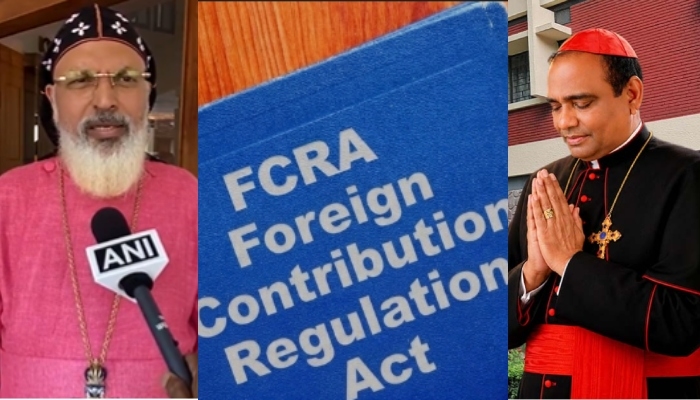
Bishop Yuhanon Mar Diascoros (L); CBCI President H.E. Anthony Cardinal Poola (R)
Furthermore, the amendments introduce an additional layer of transparency by mandating that associations disclose whether they or any of their key functionaries have released any form of publication during the year, which includes books, magazines, newspaper articles, and other similar content.It is worth noting that these disclosure requirements are not targeted at any specific religious community but apply uniformly to all FCRA-registered organisations across the country. The concerns raised by Kerala's church bodies appear to stem primarily from the expanded scope of reporting obligations, particularly those touching on publications and digital presence, areas that religious institutions have traditionally operated in with minimal regulatory scrutiny.
Kerala Catholic Bishops’ Council (KCBC) says-
Reacting to the changes, Fr Dr Michael Pulickal, secretary of the Jagratha Commission of the Kerala Catholic Bishops’ Council (KCBC), said several provisions in the amended rules have raised serious concerns among church-run institutions and voluntary organisations. “The central government says the amendments are intended to ensure transparency and regulate foreign funds. However, the new norms require even publication activities undertaken by institutions or their office-bearers to be reported in annual returns. Many of the provisions are anti-democratic and infringe upon fundamental rights, including freedom of expression,” he said.
Fr Pulickal also expressed apprehension over provisions aimed at preventing religious conversions, arguing that such clauses could be misused and may affect the freedom of religion guaranteed by the Constitution. He urged the Centre to address the concerns raised by organisations working in the sector.
Kerala Latin Catholic Association (KLCA) says-
The Kerala Latin Catholic Association (KLCA) said the amendments had been introduced without adequate consultation with stakeholders directly affected by the law. In a joint statement, KLCA state spiritual advisor Mon Jose Navas, president Sherry J Thomas, and general secretary Biju Jose said the changes have created uncertainty among institutions that have been functioning legally and peacefully in the country.
“These decisions have been taken unilaterally without consulting organisations that will be impacted by them. The amendments are seen as part of a broader tightening of restrictions on voluntary organisations and institutions. The authorities should take steps to address the concerns of such organisations and ensure a smooth working environment,” the statement said.
Under the amended rules, organisations seeking foreign contributions must either be registered under the FCRA or obtain prior permission from the Ministry of Home Affairs. The amendments also remove provisions that allowed broader permissions, making compliance requirements more stringent for entities seeking access to foreign funds.
Malankara Orthodox Syrian Church says-
Bishop Yuhanon Mar Diascoros commented on the same development, saying that the amendment was undemocratic and that it would affect the 'noble' cause of charity undertaken by the churches. "About the FCRA new rule, the church has put forth its own opinion. It is a policy in connection with all the accounts of the church. The church is one diocese, individual parishes with their organisations, and all charity institutions. Everyone clearly holds the accounts and submits to the concerned bodies properly. This is what is happening. But at present, the FCRA rule is something that intervenes in the affairs of the church and society. That is against the democratic nature of the country. This is what the church feels. So the government of India has to understand properly what is happening and what the impact of all these things is. We request them to change this new FCRA rule to allow the churches and other organisations that are doing a lot of charity work in society," he said.
#WATCH | Kottayam, Kerala: On new FCRA regulation, Malagkara Orthodox Church Bishop, Yuhanon Mar Diascoros says, "... With regard to the FCRA new rule, the church has put its own opinion. It is a policy in connection with all the accounts of the church. The church is one diocese,… pic.twitter.com/Fu9m89NgLv
— ANI (@ANI) June 25, 2026
Catholic Bishops’ Conference of India (CBCI) calls for a nationwide 'prayer protest'
The Catholic Church has announced a nationwide 'prayer meeting' scheduled for Sunday, June 28, in protest against the government's move to tighten regulations under the FCRA, 2010. The decision was publicly announced by Father Mathew Koyickal, Deputy General Secretary of the Catholic Bishops' Conference of India (CBCI), on Wednesday, June 24.
In its official notification, the CBCI stated that the proposed legislation generated concerns regarding its potential impact on the charitable, educational, healthcare, and social ministries undertaken by Churches and Christian institutions throughout the country. The official circular also encourages 'dioceses, parishes, institutions, and communities to prepare memoranda expressing concerns regarding the proposed legislation and its possible implications for the Church’s ministries'. "These memoranda, signed by the faithful and people of goodwill, may be submitted to the Central Government through local Members of Parliament and Members of the Legislative Assemblies, who may also be invited to participate in the prayer gatherings," it read.
The Union Ministry of Home Affairs recently amended the FCRA rules, introducing a more stringent compliance framework for NGOs and associations that receive foreign funds. The government formally notified the 10th amendment to the FCRA, 2010, in June, bringing several significant procedural changes into effect.
Under the revised rules, organisations are now required to clearly specify the purpose for which foreign contributions will be utilised, as well as the specific states or Union Territories where the funds are intended to be deployed. The earlier practice of citing broad, generalised objectives is no longer sufficient.
Instead, applicants must now choose their activities from a government-approved list that spans sectors including education, culture, social welfare, economic development, and religious activities. This shift from open-ended declarations to a structured, category-based selection system marks a notable tightening of the registration process. Additionally, the approved purposes and designated operational areas will henceforth be explicitly recorded and reflected on each organisation's FCRA registration certificate, ensuring greater transparency and accountability in the utilisation of foreign funds.
Parent Foreign Contribution (Regulation) Act, 2010, not altered; just the rules tightened
It is important to note that the recent amendment proposed by the Indian government in no way alters the main FCRA itself, the Foreign Contribution (Regulation) Act, 2010. However, the Rules, which are the subordinate, delegated laws formed under the parent Act, are what have been changed.
As per the official gazette, if any religious NGO registered under FCRA wants to change its area of operation or alter any purpose from its already available registration certificate, it must seek government approval. Notably, the Central Government can then approve or reject the application after due inquiry.
This section lists 16 permitted activities that religious organisations can carry out using foreign contributions, which include, construction and maintenance of places of worship, preservation of sacred scriptures, supporting institutions studying religious philosophy, pilgrim amenities, dharamshalas and langars, religious education and meditation retreats, devotional music and theatre, documentation of indigenous faith practices, protection of sacred relics and heritage sites, archiving of religious rituals, inter-faith dialogue, religious publications and research, religious libraries and museums, faith-based counselling and de-addiction centres, training in traditional sacred crafts, and burial or cremation ground maintenance. However, any of these activities undertaken with the intention of performing proselytisation has been specifically excluded.
Licenses cancelled over misutilising foreign contributions in the past
The Foreign Contribution (Regulation) Act (FCRA) has been viewed as the most debated regulatory instrument governing India's NGO sector, but in fact, it is not. It is often characterized as a restrictive tool. However, a critical assessment must acknowledge its fundamental purpose, ensuring that foreign funds entering India's civil society ecosystem are received and utilised with full transparency.
Foreign contributions can legitimately support charitable, educational, and humanitarian work. At the same time, nations have a reasonable interest in monitoring how foreign money flows into domestic civil society. Most countries maintain some form of regulatory framework for this purpose, and India is no exception.
The FCRA has emerged as one of the government's principal tools for monitoring the flow and utilisation of foreign funds by NGOs and religious organisations operating in India. Over the past decade, investigations conducted under the FCRA framework have led to the suspension or cancellation of the licences of several organisations accused of violating funding norms, misutilising foreign contributions, or engaging in activities that authorities alleged were linked to unlawful religious conversion practices. The Act requires organisations receiving foreign funds to disclose their sources of funding, maintain separate accounts, and submit periodic financial reports, thereby increasing transparency and regulatory oversight.
Union Home Minister Amit Shah has consistently called for stricter FCRA regulations time and again, arguing that while genuine social service organisations have nothing to fear, some NGOs have allegedly misused foreign funds for activities detrimental to national interests, including religious conversions and other unlawful activities. In 2022, Shah stated that the government had strengthened the FCRA and cancelled the licences of certain organisations because some NGOs were allegedly involved in religious conversions, anti-national activities, and misuse of foreign contributions. According to the government, stronger compliance requirements are intended to enhance accountability, ensure transparency in foreign funding, and safeguard national interests while allowing legitimate charitable and developmental work to continue.