Tariffs, trade, and trust: Why India's response to the US Section 301 probe deserves global attention
NewsBharati 14-Jul-2026 12:00:10 PM
Total Views |


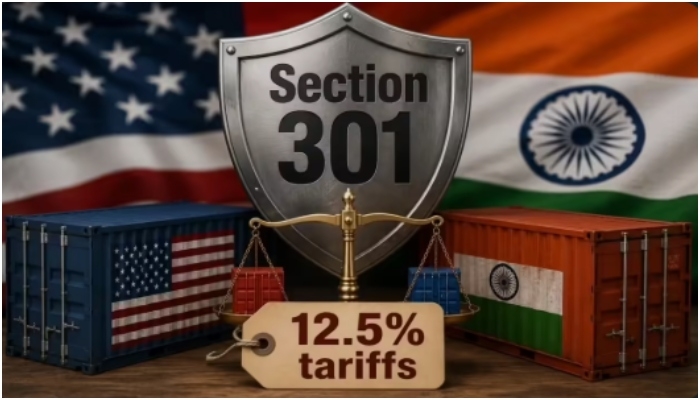
The latest tariff proposal by the United States under Section 301 of the US Trade Act is more than another trade dispute; it is a defining moment in the evolving economic relationship between the world's two largest democracies. While the proposed additional 12.5% tariff on imports from India, over alleged deficiencies in addressing forced labour, has generated concern among exporters, India's evidence-based response reflects confidence, legal preparedness, and strategic economic thinking.
Trade policy today extends far beyond customs duties. It increasingly incorporates labour standards, environmental regulations, supply chain governance and national security. As a result, commercial negotiations have become intertwined with geopolitical priorities. The current Section 301 investigation is a clear illustration of this shift.
_202607141159003992_H@@IGHT_400_W@@IDTH_700.jpg "US tarrif")
The Trump administration's decision to advance investigations under Section 301 comes at a particularly sensitive time. India and the United States are simultaneously negotiating the first phase of a Bilateral Trade Agreement (BTA), aimed at improving market access, reducing tariff barriers, and strengthening economic cooperation. Any unilateral tariff action, therefore, carries implications that extend well beyond individual sectors.
This distinction is economically significant. International trade law is built upon principles of transparency, proportionality, and evidence. Measures that affect billions of dollars in trade should be supported by rigorous empirical analysis rather than generalised assumptions. India's insistence on a fact-based assessment reinforces the importance of maintaining credibility within the multilateral trading system.
The economic consequences of additional tariffs extend far beyond exporters. Tariffs operate as taxes on imports, and numerous empirical studies have demonstrated that a substantial portion of these costs is ultimately borne by importers, manufacturers, and consumers. In integrated global value chains, intermediate goods often cross borders multiple times before reaching the final consumer. Consequently, higher tariffs increase production costs, reduce supply chain efficiency, and contribute to inflationary pressures.
India's counterarguments are further supported by available trade evidence. Government submissions indicate that imports of several American products into India have increased significantly over recent years. In one example cited during the proceedings, imports of US cotton expanded substantially even as imports from China declined, suggesting that trade patterns do not support the allegation that Indian policies have unfairly displaced American producers. Similar observations were presented regarding agricultural commodities referenced in the USTR investigation.
Equally important is India's evolving position within the global economy. According to the International Monetary Fund, India continues to be among the fastest-growing major economies, with medium-term real GDP growth projected to remain above 6 percent. The country's expanding manufacturing base, digital economy, infrastructure investment, and services exports have strengthened its resilience against external shocks.
Moreover, India's services sector continues to demonstrate exceptional strength. According to the Department of Commerce, India's services exports reached a record level during FY2024–25, driven primarily by information technology, financial services, consulting and business process outsourcing. This sustained performance has strengthened India's external sector and reinforced its position as a leading global knowledge economy.
Against this backdrop, the proposed tariff should not be viewed solely as a punitive trade measure. It is also a negotiating instrument within a broader geopolitical and commercial dialogue. Major economies frequently use trade policy to secure strategic objectives, influence regulatory standards and strengthen bargaining positions during bilateral negotiations. The Section 301 investigation therefore reflects both economic and geopolitical considerations.
The challenge before policymakers is to ensure that legitimate concerns regarding labour standards are addressed through evidence-based cooperation rather than unilateral trade restrictions. A durable economic partnership between India and the United States cannot be built on uncertainty or escalating tariffs; it must rest on mutual trust, transparent rules and shared long-term interests.

This consideration assumes greater significance as companies continue to diversify manufacturing locations under the "China Plus One" strategy. India has emerged as a preferred destination for investment in electronics, pharmaceuticals, renewable energy equipment, and engineering products. According to the Department for Promotion of Industry and Internal Trade (DPIIT), India has consistently attracted substantial foreign direct investment over the past decade, supported by policy initiatives such as the Production Linked Incentive (PLI) schemes, improvements in logistics infrastructure and the digitisation of business processes.
The proposed tariff also has implications for American businesses. Indian companies export a wide range of intermediate goods that are integrated into US manufacturing and retail supply chains. Higher duties on these imports could increase production costs for American manufacturers, reduce margins for importers, and eventually raise prices for consumers. In an era characterised by persistent inflationary pressures and supply chain disruptions, additional tariffs may produce consequences extending beyond the immediate objective of trade enforcement.
Several Indian exporters have expressed similar concerns during the USTR consultation process. Firms operating in textiles, petrochemicals, processed food, renewable energy components, and engineering products have argued that additional tariffs would adversely affect commercial relationships developed over decades. Exporters of dehydrated onions, garlic, and processed agricultural products have also noted that increased duties would ultimately be reflected in higher costs for American food processors and consumers rather than delivering meaningful improvements in labour standards.
The current dispute also offers India an opportunity for strategic introspection. First, export diversification must continue beyond traditional sectors into high-value manufacturing, green technologies, semiconductors, electric mobility and advanced engineering. Second, Indian exporters should strengthen environmental, social and governance (ESG) compliance and supply chain traceability to meet evolving global market expectations. Third, investments in logistics efficiency, port modernisation and customs facilitation should remain central to India's export competitiveness.
From a macroeconomic perspective, India's external position remains relatively resilient. The Reserve Bank of India has consistently highlighted the strength of India's foreign exchange reserves, the resilience of services exports, and the country's ability to withstand global economic volatility. Simultaneously, the International Monetary Fund continues to project India as one of the fastest-growing major economies, supported by robust domestic demand, public investment and structural reforms. These fundamentals provide confidence that temporary trade frictions, while important, are unlikely to alter India's long-term growth trajectory.
For the United States, India represents more than an export market. It is a strategic partner in the Indo-Pacific, a trusted participant in critical technology partnerships, an increasingly important defence collaborator and a key contributor to resilient global supply chains. Cooperation in semiconductors, clean energy, artificial intelligence, pharmaceuticals, and critical minerals has expanded significantly in recent years. These shared strategic interests argue strongly in favour of resolving trade disagreements through institutional mechanisms rather than prolonged tariff escalation.
Looking ahead, the proposed India–US Bilateral Trade Agreement presents an opportunity to redefine economic cooperation for the coming decade. A comprehensive agreement that reduces unnecessary trade barriers, promotes investment, strengthens intellectual property protection, facilitates digital trade, and improves regulatory cooperation would generate mutual benefits for businesses, consumers, and workers in both countries. Such an agreement should preserve India's competitive position while addressing legitimate concerns through evidence-based policy dialogue.
The broader lesson from the current Section 301 investigation is that modern trade policy must balance national interests with international cooperation. Economic resilience cannot be built through protectionism alone, nor can sustainable globalisation flourish without respect for labour rights, transparency and fair competition. The challenge lies in achieving this balance without undermining the stability of global value chains.
India's response to the proposed tariff reflects precisely such an approach. By defending its position through legal arguments, empirical evidence and constructive diplomacy, India has demonstrated that responsible economic leadership is not measured by confrontation but by confidence in institutions and commitment to rules-based engagement.
As the two democracies continue negotiations, both have far more to gain from partnership than from prolonged trade disputes. Their combined economic potential, technological capabilities and strategic convergence position them to shape the future of global commerce. The present disagreement should therefore be viewed not as a setback but as an opportunity to build a more transparent, resilient and mutually beneficial trade architecture.
In international trade, trust is ultimately a more valuable asset than tariffs. India and the United States now have an opportunity to reaffirm that principle.
(The author is Dr. Lavkush Singh, Economic Analyst. The views expressed are personal)
Trade policy today extends far beyond customs duties. It increasingly incorporates labour standards, environmental regulations, supply chain governance and national security. As a result, commercial negotiations have become intertwined with geopolitical priorities. The current Section 301 investigation is a clear illustration of this shift.
According to the Office of the United States Trade Representative (USTR), total bilateral goods and services trade between India and the United States reached approximately US$212.3 billion in 2024, making the United States India's largest trading partner. During the same period, the United States recorded a goods trade deficit of US$45.7 billion with India. These figures highlight not only the scale of bilateral commerce but also the strategic importance of maintaining a predictable and rules-based trading relationship.
The Trump administration's decision to advance investigations under Section 301 comes at a particularly sensitive time. India and the United States are simultaneously negotiating the first phase of a Bilateral Trade Agreement (BTA), aimed at improving market access, reducing tariff barriers, and strengthening economic cooperation. Any unilateral tariff action, therefore, carries implications that extend well beyond individual sectors.
India's official response has been both measured and legally robust. In its submission to the USTR, the Government of India argued that the proposed tariff fails to satisfy the statutory requirements under Section 301(d) of the US Trade Act. The submission contends that the investigation does not provide country-specific evidence demonstrating that India's policies or practices have burdened or restricted US commerce. Instead, it relies on broad trade patterns and isolated examples without establishing a direct causal relationship between Indian policies and measurable injury to American businesses.
This distinction is economically significant. International trade law is built upon principles of transparency, proportionality, and evidence. Measures that affect billions of dollars in trade should be supported by rigorous empirical analysis rather than generalised assumptions. India's insistence on a fact-based assessment reinforces the importance of maintaining credibility within the multilateral trading system.
The economic consequences of additional tariffs extend far beyond exporters. Tariffs operate as taxes on imports, and numerous empirical studies have demonstrated that a substantial portion of these costs is ultimately borne by importers, manufacturers, and consumers. In integrated global value chains, intermediate goods often cross borders multiple times before reaching the final consumer. Consequently, higher tariffs increase production costs, reduce supply chain efficiency, and contribute to inflationary pressures.
This is particularly relevant in the India–US context. Indian exports to the United States include engineering goods, pharmaceuticals, chemicals, textiles, information technology services, gems and jewellery, agricultural products, and increasingly sophisticated manufacturing inputs. Many of these products are not final consumer goods but components used by American industries. Additional duties, therefore, have the potential to raise costs for US manufacturers and reduce their international competitiveness.
India's counterarguments are further supported by available trade evidence. Government submissions indicate that imports of several American products into India have increased significantly over recent years. In one example cited during the proceedings, imports of US cotton expanded substantially even as imports from China declined, suggesting that trade patterns do not support the allegation that Indian policies have unfairly displaced American producers. Similar observations were presented regarding agricultural commodities referenced in the USTR investigation.
Equally important is India's evolving position within the global economy. According to the International Monetary Fund, India continues to be among the fastest-growing major economies, with medium-term real GDP growth projected to remain above 6 percent. The country's expanding manufacturing base, digital economy, infrastructure investment, and services exports have strengthened its resilience against external shocks.
Today, India's export profile is considerably more diversified than it was a decade ago. Engineering goods, electronics, pharmaceuticals, petroleum products, chemicals, processed food, and digital services collectively account for a substantial share of export earnings. This diversification reduces dependence on any single market or product category and enhances India's capacity to adapt to changing global trade conditions.
Moreover, India's services sector continues to demonstrate exceptional strength. According to the Department of Commerce, India's services exports reached a record level during FY2024–25, driven primarily by information technology, financial services, consulting and business process outsourcing. This sustained performance has strengthened India's external sector and reinforced its position as a leading global knowledge economy.
Against this backdrop, the proposed tariff should not be viewed solely as a punitive trade measure. It is also a negotiating instrument within a broader geopolitical and commercial dialogue. Major economies frequently use trade policy to secure strategic objectives, influence regulatory standards and strengthen bargaining positions during bilateral negotiations. The Section 301 investigation therefore reflects both economic and geopolitical considerations.
The challenge before policymakers is to ensure that legitimate concerns regarding labour standards are addressed through evidence-based cooperation rather than unilateral trade restrictions. A durable economic partnership between India and the United States cannot be built on uncertainty or escalating tariffs; it must rest on mutual trust, transparent rules and shared long-term interests.
One of India's principal negotiating objectives is to secure a tariff framework that preserves its competitive position relative to other major exporting economies, particularly China, Vietnam, Bangladesh and members of the Association of Southeast Asian Nations (ASEAN). In today's interconnected trading system, competitiveness is determined not only by production costs but also by preferential market access. Even a modest tariff differential can influence sourcing decisions by multinational corporations and reshape global supply chains.
This consideration assumes greater significance as companies continue to diversify manufacturing locations under the "China Plus One" strategy. India has emerged as a preferred destination for investment in electronics, pharmaceuticals, renewable energy equipment, and engineering products. According to the Department for Promotion of Industry and Internal Trade (DPIIT), India has consistently attracted substantial foreign direct investment over the past decade, supported by policy initiatives such as the Production Linked Incentive (PLI) schemes, improvements in logistics infrastructure and the digitisation of business processes.
The proposed tariff also has implications for American businesses. Indian companies export a wide range of intermediate goods that are integrated into US manufacturing and retail supply chains. Higher duties on these imports could increase production costs for American manufacturers, reduce margins for importers, and eventually raise prices for consumers. In an era characterised by persistent inflationary pressures and supply chain disruptions, additional tariffs may produce consequences extending beyond the immediate objective of trade enforcement.
Several Indian exporters have expressed similar concerns during the USTR consultation process. Firms operating in textiles, petrochemicals, processed food, renewable energy components, and engineering products have argued that additional tariffs would adversely affect commercial relationships developed over decades. Exporters of dehydrated onions, garlic, and processed agricultural products have also noted that increased duties would ultimately be reflected in higher costs for American food processors and consumers rather than delivering meaningful improvements in labour standards.
It is equally important to recognise that labour rights and responsible business practices are legitimate global concerns. India has strengthened labour governance through the consolidation of labour laws into four Labour Codes, increased digitalisation of compliance systems and wider use of technology in labour administration. While implementation remains a continuing process, these reforms demonstrate a commitment to improving transparency, simplifying regulation, and enhancing worker protection. Constructive engagement on labour standards should therefore encourage capacity building, technical cooperation and institutional dialogue rather than relying primarily on punitive trade measures.
The current dispute also offers India an opportunity for strategic introspection. First, export diversification must continue beyond traditional sectors into high-value manufacturing, green technologies, semiconductors, electric mobility and advanced engineering. Second, Indian exporters should strengthen environmental, social and governance (ESG) compliance and supply chain traceability to meet evolving global market expectations. Third, investments in logistics efficiency, port modernisation and customs facilitation should remain central to India's export competitiveness.
From a macroeconomic perspective, India's external position remains relatively resilient. The Reserve Bank of India has consistently highlighted the strength of India's foreign exchange reserves, the resilience of services exports, and the country's ability to withstand global economic volatility. Simultaneously, the International Monetary Fund continues to project India as one of the fastest-growing major economies, supported by robust domestic demand, public investment and structural reforms. These fundamentals provide confidence that temporary trade frictions, while important, are unlikely to alter India's long-term growth trajectory.
For the United States, India represents more than an export market. It is a strategic partner in the Indo-Pacific, a trusted participant in critical technology partnerships, an increasingly important defence collaborator and a key contributor to resilient global supply chains. Cooperation in semiconductors, clean energy, artificial intelligence, pharmaceuticals, and critical minerals has expanded significantly in recent years. These shared strategic interests argue strongly in favour of resolving trade disagreements through institutional mechanisms rather than prolonged tariff escalation.
Looking ahead, the proposed India–US Bilateral Trade Agreement presents an opportunity to redefine economic cooperation for the coming decade. A comprehensive agreement that reduces unnecessary trade barriers, promotes investment, strengthens intellectual property protection, facilitates digital trade, and improves regulatory cooperation would generate mutual benefits for businesses, consumers, and workers in both countries. Such an agreement should preserve India's competitive position while addressing legitimate concerns through evidence-based policy dialogue.
The broader lesson from the current Section 301 investigation is that modern trade policy must balance national interests with international cooperation. Economic resilience cannot be built through protectionism alone, nor can sustainable globalisation flourish without respect for labour rights, transparency and fair competition. The challenge lies in achieving this balance without undermining the stability of global value chains.
India's response to the proposed tariff reflects precisely such an approach. By defending its position through legal arguments, empirical evidence and constructive diplomacy, India has demonstrated that responsible economic leadership is not measured by confrontation but by confidence in institutions and commitment to rules-based engagement.
As the two democracies continue negotiations, both have far more to gain from partnership than from prolonged trade disputes. Their combined economic potential, technological capabilities and strategic convergence position them to shape the future of global commerce. The present disagreement should therefore be viewed not as a setback but as an opportunity to build a more transparent, resilient and mutually beneficial trade architecture.
In international trade, trust is ultimately a more valuable asset than tariffs. India and the United States now have an opportunity to reaffirm that principle.
(The author is Dr. Lavkush Singh, Economic Analyst. The views expressed are personal)

Dr Luvkush Singh
Dr. Lavkush Singh is a distinguished academician, economic analyst, researcher, author, academic administrator, and NCC officer with nearly 18 years of rich experience in higher education, research, institutional development, and academic leadership. He currently serves as Associate Professor and Director In-Charge at the International Institute of Management and Human Resource Development for Women, Pune. His contribution to women's management education, leadership development, and skill enhancement is noteworthy.
His commitment to education, dedication to research, and vision for nation-building have earned him a distinct identity in the contemporary academic world. He earned his Ph.D. in Business Administration from Savitribai Phule Pune University. In addition, he holds advanced academic qualifications including an M.Com (Accounting and Taxation), M.A. (Economics), and MBA (Finance), and was also enrolled in CA-IPCC.
Dr. Singh secured third rank in Maharashtra in Commerce in the National Eligibility Test (NET) held in 2012, and cleared UGC-NET in Economics in 2019. This achievement reflects his multidisciplinary academic proficiency and intellectual capability.
His contribution in the field of writing and knowledge creation is highly significant. He has authored 41 books so far, covering subjects such as financial management, managerial economics, the Indian economy, cost and management accounting, strategic management, business law, business mathematics, business research methodology, and qualitative research methodology. His books are widely used as important reference material by students, researchers, and teachers across the country.
His contribution to research is also remarkable. He has published 64 research papers in prestigious national and international journals, including those indexed in Scopus, SCI, ABDC, and UGC CARE. He has registered two patents, with a third currently in process. He has been honored with the "Best Peer Reviewer" recognition by 12 international research journals.
His commitment to education, dedication to research, and vision for nation-building have earned him a distinct identity in the contemporary academic world. He earned his Ph.D. in Business Administration from Savitribai Phule Pune University. In addition, he holds advanced academic qualifications including an M.Com (Accounting and Taxation), M.A. (Economics), and MBA (Finance), and was also enrolled in CA-IPCC.
Dr. Singh secured third rank in Maharashtra in Commerce in the National Eligibility Test (NET) held in 2012, and cleared UGC-NET in Economics in 2019. This achievement reflects his multidisciplinary academic proficiency and intellectual capability.
His contribution in the field of writing and knowledge creation is highly significant. He has authored 41 books so far, covering subjects such as financial management, managerial economics, the Indian economy, cost and management accounting, strategic management, business law, business mathematics, business research methodology, and qualitative research methodology. His books are widely used as important reference material by students, researchers, and teachers across the country.
His contribution to research is also remarkable. He has published 64 research papers in prestigious national and international journals, including those indexed in Scopus, SCI, ABDC, and UGC CARE. He has registered two patents, with a third currently in process. He has been honored with the "Best Peer Reviewer" recognition by 12 international research journals.