100% Tariff Threat on Russian Oil Buyers: Why India Has More Options Than It Appears
India"s merchandise exports reached a record $441.8 billion in FY2025-26, while total exports, including services, reached $863.1 billion.
NewsBharati 11-Aug-2026 12:00:32 PM
Total Views |


The possibility of the United States imposing a punitive tariff of up to 100% on countries continuing to purchase Russian crude oil has once again brought India's energy security and export strategy into sharp focus. For India, the issue is not simply about choosing between Russian oil and American pressure. It is about managing two large economic relationships simultaneously, energy security on one side and access to the US market on the other.
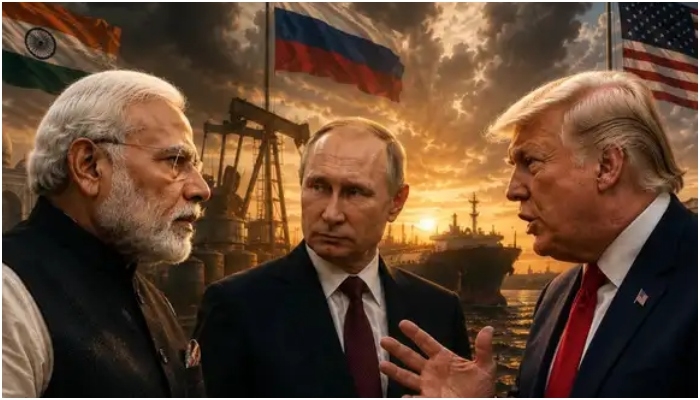
The US is India's largest export market, but not the only one
India's merchandise exports reached a record $441.8 billion in FY2025-26, while total exports, including services, reached $863.1 billion.
According to economist S.P. Sharma, India's merchandise exports to the US were approximately $87.3 billion in FY2025-26, compared with $86.5 billion in FY2024-25. He argues that Indian exporters have around 15 alternative markets where similar products can potentially be sold, representing a market opportunity of about $200 billion.
The arithmetic itself is significant. India's $87.3 billion merchandise exports to the US represented roughly 19.8% of India's total merchandise exports in FY2025-26. The $200 billion alternative-market opportunity cited by Sharma is more than twice the current value of India's merchandise exports to the US.
However, this should not be interpreted as saying that $200 billion can immediately replace US demand. Market access, product standards, logistics, consumer preferences, tariffs, distribution networks and payment arrangements all matter. The figure is better understood as potential addressable demand, not guaranteed replacement exports.
India's export diversification is already visible
The government's trade data show that the United States is only one part of India's global export network. The Department of Commerce identifies the US, UAE, China, Netherlands and UK among India's largest export destinations. Together, the top destinations account for a substantial share of India's merchandise exports.
The UAE, UK and European markets are particularly important because India's export basket already contains products that have established demand in these markets. Textiles provide a useful example. India's textile and apparel exports, including handicrafts, increased from ₹2.97 lakh crore in FY2023-24 to ₹3.25 lakh crore in FY2025-26. Exports of these products to the UAE increased to ₹20,775 crore, while exports to the UK reached ₹19,652 crore and exports to the Netherlands reached ₹10,461 crore in FY2025-26.
Therefore, diversification is not merely a theoretical possibility. Indian products already have established markets outside the US.
But Russian crude is a different challenge
The energy side of the equation is considerably more difficult.
India remains highly dependent on imported crude oil. According to data cited by the Petroleum Planning and Analysis Cell, India's crude oil import dependence remained around 88% in FY2025-26.
This means that replacing Russian crude is not simply a question of finding another supplier. It can affect India's import bill, inflation, current account balance, refinery margins and ultimately the prices paid by consumers.
Russian crude became particularly important because discounted Russian supplies offered Indian refiners an opportunity to reduce their crude acquisition costs after the Russia-Ukraine conflict disrupted traditional oil trade flows.
The scale of dependence has varied sharply over time. In June 2026, Russian crude reportedly reached about 2.6 million barrels per day, accounting for approximately 52% of India's crude imports for that month.
That June number should not be treated as a normal annual average. It was influenced by extraordinary geopolitical conditions, including disruptions to West Asian supplies. Nevertheless, it demonstrates how quickly India's crude basket can become concentrated in one supplier when price and availability conditions change.
What would replacing Russian oil cost?
This is where scenario analysis becomes useful.
If India's Russian crude purchases were maintained at the June level of 2.6 million barrels per day, the annualised volume would be approximately 949 million barrels.
The economic impact of replacing this volume would depend primarily on the price differential between Russian crude and alternative supplies.
For illustration:

These are scenario estimates, not forecasts.
The exercise nevertheless shows why India cannot treat Russian crude merely as a geopolitical issue. Even a $10-per-barrel increase on a very large annualised volume could create an additional import burden of nearly $9.5 billion.
The bigger danger may be oil prices, not tariffs alone
India's vulnerability could become greater if restrictions on Russian oil reduce global supply and push international crude prices higher.
India imports around 88% of its crude requirement. Therefore, a sustained global oil-price increase can affect the economy through several channels:
Higher crude prices → higher import bill → wider trade deficit → pressure on the rupee → higher input costs → inflationary pressure → weaker household purchasing power.
The effect does not necessarily mean that petrol and diesel prices will rise by the same percentage as crude oil. Refining margins, taxes, exchange rates, government policy and marketing-company pricing also influence retail fuel prices.
Nevertheless, India's high import dependence makes oil-price volatility a major macroeconomic risk.
Can India replace the US market? Yes—but not overnight
The argument that India has 15 alternative markets is economically important, but it should not be exaggerated.
Suppose India's $87.3 billion in US merchandise exports were affected by severe trade restrictions. Even if only part of this trade had to be redirected, the adjustment would be substantial.
A simple scenario illustrates the scale:

These figures do not represent expected losses. They simply show the value of exports that would require alternative markets under different exposure scenarios.
If India could redirect even 25% of the current US export exposure over time, approximately $21.8 billion of merchandise trade would need to find alternative demand.
That is difficult—but not impossible for an economy with $441.8 billion of annual merchandise exports and a network covering more than 200 trading partners. The Department of Commerce trade platform records more than 217 trading partners and 53 FTA partners.
Where should India look?
The immediate candidates include the European Union, UAE, UK, Saudi Arabia, Latin America, Africa and neighbouring Asian markets.
India's strategy should not be to find one substitute for the US. It should instead create a portfolio of markets.
For example:
Europe can absorb higher-value engineering, pharmaceutical, textile and chemical products.
The Gulf can support food, engineering, consumer and construction-related exports.
Africa provides opportunities in pharmaceuticals, automobiles, machinery and processed food.
Latin America remains an underdeveloped destination for several Indian product categories.
ASEAN markets offer opportunities in engineering goods, chemicals, pharmaceuticals and manufactured products.
This approach reduces the risk associated with dependence on any single country.
The US itself could face costs
A 100% tariff would not necessarily mean that the economic cost is borne entirely by Indian exporters.
If Indian products become significantly more expensive in the United States, American importers may search for alternative suppliers. But substitution is not costless.
India is particularly competitive in several labour-intensive sectors, including textiles, garments, pharmaceuticals, gems and jewellery, engineering products, and selected agricultural and processed food products.
Therefore, an excessively high tariff could create a difficult choice for American buyers: pay more for Indian products, switch suppliers, or reduce consumption.
India's strongest response is diversification—not confrontation
India does not need to choose between the US and Russia in absolute terms.
Its economic interest is better served by maintaining diversified energy supplies and diversified export markets simultaneously.
The government has already increased the number of countries from which India sources crude oil to 41, up from 27, according to information reported to Parliament.
That is the right direction.
The objective should be to ensure that no single supplier accounts for such a large share of India's energy requirement that geopolitical pressure can translate directly into domestic economic instability.
Similarly, no single export destination should become so dominant that a tariff decision can materially disrupt India's manufacturing and employment ecosystem.
The opportunity behind the threat
The current tariff dispute therefore presents India with a strategic opportunity.
The immediate challenge is to protect existing exports and maintain affordable energy supplies. The medium-term opportunity is much larger: India can use geopolitical uncertainty to accelerate export-market diversification, strengthen FTAs, expand manufacturing competitiveness and develop new energy relationships.
The country's record $863.1 billion total exports in FY2025-26 demonstrate that India's external sector is already operating at a much larger scale than it was a decade ago.
But diversification must go beyond signing trade agreements. Indian companies need competitive logistics, reliable electricity, faster customs procedures, quality certification, export finance and globally competitive production costs.
_202608111210307859_H@@IGHT_400_W@@IDTH_700.jpg "Russia Oil") India's next move
India's next move
India's most rational response to the 100% tariff threat is therefore neither immediate confrontation nor panic-driven retreat.
It should follow a three-part strategy:
First, protect energy security. Maintain multiple crude suppliers and avoid excessive dependence on any single country.
Second, protect export competitiveness. Continue negotiations with the US while simultaneously accelerating access to Europe, the Gulf, Africa, Latin America and Asia.
Third, reduce structural vulnerability. Invest in domestic energy production, renewables, storage, refining efficiency, strategic reserves and higher-value manufacturing.
The US remains an exceptionally important market, and losing access to it would have real costs. At the same time, India's expanding export network means that the country is not without alternatives.
The $200-billion alternative-market estimate cited by S.P. Sharma should therefore be viewed neither as a guaranteed replacement for the US nor as an unrealistic number. It is better understood as a reminder of India's untapped market-diversification potential.
The real test for Indian policymakers and exporters is whether that potential can be converted into actual orders, investment, production and employment.
In the emerging global trading environment, diversification is no longer simply an export strategy—it is an economic-security strategy.
The immediate concern is understandable. The United States is one of India's most important export destinations, while Russia has become a major source of India's crude oil. However, the available trade data suggest that India's vulnerability is significant but not absolute. India has a large and increasingly diversified trading network, and the government says the country now sources crude oil from 41 countries, compared with 27 earlier.
The US is India's largest export market, but not the only one
India's merchandise exports reached a record $441.8 billion in FY2025-26, while total exports, including services, reached $863.1 billion.
According to economist S.P. Sharma, India's merchandise exports to the US were approximately $87.3 billion in FY2025-26, compared with $86.5 billion in FY2024-25. He argues that Indian exporters have around 15 alternative markets where similar products can potentially be sold, representing a market opportunity of about $200 billion.
The arithmetic itself is significant. India's $87.3 billion merchandise exports to the US represented roughly 19.8% of India's total merchandise exports in FY2025-26. The $200 billion alternative-market opportunity cited by Sharma is more than twice the current value of India's merchandise exports to the US.
However, this should not be interpreted as saying that $200 billion can immediately replace US demand. Market access, product standards, logistics, consumer preferences, tariffs, distribution networks and payment arrangements all matter. The figure is better understood as potential addressable demand, not guaranteed replacement exports.
India's export diversification is already visible
The government's trade data show that the United States is only one part of India's global export network. The Department of Commerce identifies the US, UAE, China, Netherlands and UK among India's largest export destinations. Together, the top destinations account for a substantial share of India's merchandise exports.
This diversification provides India with an important strategic advantage.
The UAE, UK and European markets are particularly important because India's export basket already contains products that have established demand in these markets. Textiles provide a useful example. India's textile and apparel exports, including handicrafts, increased from ₹2.97 lakh crore in FY2023-24 to ₹3.25 lakh crore in FY2025-26. Exports of these products to the UAE increased to ₹20,775 crore, while exports to the UK reached ₹19,652 crore and exports to the Netherlands reached ₹10,461 crore in FY2025-26.
Therefore, diversification is not merely a theoretical possibility. Indian products already have established markets outside the US.
But Russian crude is a different challenge
The energy side of the equation is considerably more difficult.
India remains highly dependent on imported crude oil. According to data cited by the Petroleum Planning and Analysis Cell, India's crude oil import dependence remained around 88% in FY2025-26.
This means that replacing Russian crude is not simply a question of finding another supplier. It can affect India's import bill, inflation, current account balance, refinery margins and ultimately the prices paid by consumers.
Russian crude became particularly important because discounted Russian supplies offered Indian refiners an opportunity to reduce their crude acquisition costs after the Russia-Ukraine conflict disrupted traditional oil trade flows.
The scale of dependence has varied sharply over time. In June 2026, Russian crude reportedly reached about 2.6 million barrels per day, accounting for approximately 52% of India's crude imports for that month.
That June number should not be treated as a normal annual average. It was influenced by extraordinary geopolitical conditions, including disruptions to West Asian supplies. Nevertheless, it demonstrates how quickly India's crude basket can become concentrated in one supplier when price and availability conditions change.
What would replacing Russian oil cost?
This is where scenario analysis becomes useful.
If India's Russian crude purchases were maintained at the June level of 2.6 million barrels per day, the annualised volume would be approximately 949 million barrels.
The economic impact of replacing this volume would depend primarily on the price differential between Russian crude and alternative supplies.
For illustration:
Illustrative calculation based on an annualised 2.6 million barrels per day; actual impact would depend on volumes, crude grades, freight, insurance, discounts and global prices.
ALSO READ: Jharkhand protest: Students walk towards Vidhan Sabha amid heavy security 'arrangements', dangerous barricades
These are scenario estimates, not forecasts.
The exercise nevertheless shows why India cannot treat Russian crude merely as a geopolitical issue. Even a $10-per-barrel increase on a very large annualised volume could create an additional import burden of nearly $9.5 billion.
The bigger danger may be oil prices, not tariffs alone
India's vulnerability could become greater if restrictions on Russian oil reduce global supply and push international crude prices higher.
India imports around 88% of its crude requirement. Therefore, a sustained global oil-price increase can affect the economy through several channels:
Higher crude prices → higher import bill → wider trade deficit → pressure on the rupee → higher input costs → inflationary pressure → weaker household purchasing power.
The effect does not necessarily mean that petrol and diesel prices will rise by the same percentage as crude oil. Refining margins, taxes, exchange rates, government policy and marketing-company pricing also influence retail fuel prices.
Nevertheless, India's high import dependence makes oil-price volatility a major macroeconomic risk.
Can India replace the US market? Yes—but not overnight
The argument that India has 15 alternative markets is economically important, but it should not be exaggerated.
Suppose India's $87.3 billion in US merchandise exports were affected by severe trade restrictions. Even if only part of this trade had to be redirected, the adjustment would be substantial.
A simple scenario illustrates the scale:
These figures do not represent expected losses. They simply show the value of exports that would require alternative markets under different exposure scenarios.
If India could redirect even 25% of the current US export exposure over time, approximately $21.8 billion of merchandise trade would need to find alternative demand.
That is difficult—but not impossible for an economy with $441.8 billion of annual merchandise exports and a network covering more than 200 trading partners. The Department of Commerce trade platform records more than 217 trading partners and 53 FTA partners.
Where should India look?
The immediate candidates include the European Union, UAE, UK, Saudi Arabia, Latin America, Africa and neighbouring Asian markets.
India's strategy should not be to find one substitute for the US. It should instead create a portfolio of markets.
For example:
Europe can absorb higher-value engineering, pharmaceutical, textile and chemical products.
The Gulf can support food, engineering, consumer and construction-related exports.
Africa provides opportunities in pharmaceuticals, automobiles, machinery and processed food.
Latin America remains an underdeveloped destination for several Indian product categories.
ASEAN markets offer opportunities in engineering goods, chemicals, pharmaceuticals and manufactured products.
This approach reduces the risk associated with dependence on any single country.
The US itself could face costs
A 100% tariff would not necessarily mean that the economic cost is borne entirely by Indian exporters.
A tariff is legally imposed on imports, and the importing side makes the immediate payment. Depending on market conditions, the cost can subsequently be distributed among American importers, consumers and foreign suppliers through changes in prices and margins.
If Indian products become significantly more expensive in the United States, American importers may search for alternative suppliers. But substitution is not costless.
India is particularly competitive in several labour-intensive sectors, including textiles, garments, pharmaceuticals, gems and jewellery, engineering products, and selected agricultural and processed food products.
Therefore, an excessively high tariff could create a difficult choice for American buyers: pay more for Indian products, switch suppliers, or reduce consumption.
India's strongest response is diversification—not confrontation
India does not need to choose between the US and Russia in absolute terms.
Its economic interest is better served by maintaining diversified energy supplies and diversified export markets simultaneously.
The government has already increased the number of countries from which India sources crude oil to 41, up from 27, according to information reported to Parliament.
That is the right direction.
The objective should be to ensure that no single supplier accounts for such a large share of India's energy requirement that geopolitical pressure can translate directly into domestic economic instability.
Similarly, no single export destination should become so dominant that a tariff decision can materially disrupt India's manufacturing and employment ecosystem.
The opportunity behind the threat
The current tariff dispute therefore presents India with a strategic opportunity.
The immediate challenge is to protect existing exports and maintain affordable energy supplies. The medium-term opportunity is much larger: India can use geopolitical uncertainty to accelerate export-market diversification, strengthen FTAs, expand manufacturing competitiveness and develop new energy relationships.
The country's record $863.1 billion total exports in FY2025-26 demonstrate that India's external sector is already operating at a much larger scale than it was a decade ago.
But diversification must go beyond signing trade agreements. Indian companies need competitive logistics, reliable electricity, faster customs procedures, quality certification, export finance and globally competitive production costs.
India's most rational response to the 100% tariff threat is therefore neither immediate confrontation nor panic-driven retreat.
It should follow a three-part strategy:
First, protect energy security. Maintain multiple crude suppliers and avoid excessive dependence on any single country.
Second, protect export competitiveness. Continue negotiations with the US while simultaneously accelerating access to Europe, the Gulf, Africa, Latin America and Asia.
Third, reduce structural vulnerability. Invest in domestic energy production, renewables, storage, refining efficiency, strategic reserves and higher-value manufacturing.
The central lesson is simple: India's economic resilience will depend less on choosing one geopolitical camp and more on ensuring that it has multiple economic options.
The US remains an exceptionally important market, and losing access to it would have real costs. At the same time, India's expanding export network means that the country is not without alternatives.
The $200-billion alternative-market estimate cited by S.P. Sharma should therefore be viewed neither as a guaranteed replacement for the US nor as an unrealistic number. It is better understood as a reminder of India's untapped market-diversification potential.
The real test for Indian policymakers and exporters is whether that potential can be converted into actual orders, investment, production and employment.
In the emerging global trading environment, diversification is no longer simply an export strategy—it is an economic-security strategy.

Dr Luvkush Singh
Dr. Lavkush Singh is a distinguished academician, economic analyst, researcher, author, academic administrator, and NCC officer with nearly 18 years of rich experience in higher education, research, institutional development, and academic leadership. He currently serves as Associate Professor and Director In-Charge at the International Institute of Management and Human Resource Development for Women, Pune. His contribution to women's management education, leadership development, and skill enhancement is noteworthy.
His commitment to education, dedication to research, and vision for nation-building have earned him a distinct identity in the contemporary academic world. He earned his Ph.D. in Business Administration from Savitribai Phule Pune University. In addition, he holds advanced academic qualifications including an M.Com (Accounting and Taxation), M.A. (Economics), and MBA (Finance), and was also enrolled in CA-IPCC.
Dr. Singh secured third rank in Maharashtra in Commerce in the National Eligibility Test (NET) held in 2012, and cleared UGC-NET in Economics in 2019. This achievement reflects his multidisciplinary academic proficiency and intellectual capability.
His contribution in the field of writing and knowledge creation is highly significant. He has authored 41 books so far, covering subjects such as financial management, managerial economics, the Indian economy, cost and management accounting, strategic management, business law, business mathematics, business research methodology, and qualitative research methodology. His books are widely used as important reference material by students, researchers, and teachers across the country.
His contribution to research is also remarkable. He has published 64 research papers in prestigious national and international journals, including those indexed in Scopus, SCI, ABDC, and UGC CARE. He has registered two patents, with a third currently in process. He has been honored with the "Best Peer Reviewer" recognition by 12 international research journals.
His commitment to education, dedication to research, and vision for nation-building have earned him a distinct identity in the contemporary academic world. He earned his Ph.D. in Business Administration from Savitribai Phule Pune University. In addition, he holds advanced academic qualifications including an M.Com (Accounting and Taxation), M.A. (Economics), and MBA (Finance), and was also enrolled in CA-IPCC.
Dr. Singh secured third rank in Maharashtra in Commerce in the National Eligibility Test (NET) held in 2012, and cleared UGC-NET in Economics in 2019. This achievement reflects his multidisciplinary academic proficiency and intellectual capability.
His contribution in the field of writing and knowledge creation is highly significant. He has authored 41 books so far, covering subjects such as financial management, managerial economics, the Indian economy, cost and management accounting, strategic management, business law, business mathematics, business research methodology, and qualitative research methodology. His books are widely used as important reference material by students, researchers, and teachers across the country.
His contribution to research is also remarkable. He has published 64 research papers in prestigious national and international journals, including those indexed in Scopus, SCI, ABDC, and UGC CARE. He has registered two patents, with a third currently in process. He has been honored with the "Best Peer Reviewer" recognition by 12 international research journals.