A slow and quiet change has been taking place across parts of India in the name of “
soul harvesting”. Christian
Missionaries and their workers have built networks that reach far beyond remote villages. Their presence is also visible in cities and affluent urban spaces. Some of this activity is documented, while some operates beyond public scrutiny. Vulnerable communities are increasingly being targeted through sustained outreach, financial assistance and promises of support. Over time, such efforts can alter local social and cultural patterns. The scale of these claims is striking. A pastor has reportedly claimed that
one lakh people were converted within a single week.
Amid these claims, an alleged conversion network came under the spotlight in Delhi. But soon after the controversy surfaced, the
Delhi Police dismissed the conversion angle, describing the gathering as a regular Sunday prayer meeting. The police also rejected the allegation that hundreds of people were being converted at the venue. Soon, a video went viral, bringing fresh allegations about what had taken place inside the venue and putting the police's version of events under renewed scrutiny.
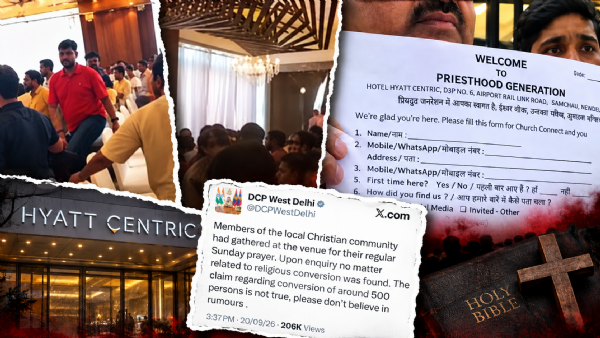
As per the reports, the incident took place on September 20 at the Hyatt Centric in Janakpuri, where a Sunday prayer meeting was underway.
The matter came to light after Hindu activist Preet Sirohi posted a video about the incident on his official X. The post stated that around 500 poor and vulnerable Hindus, including minors, had gathered at the Hyatt Hotel
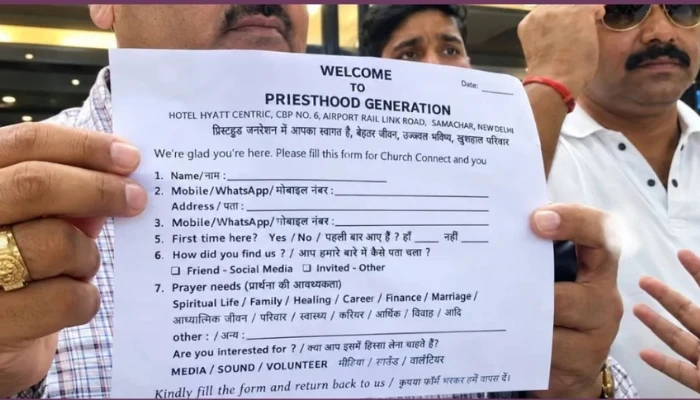
and were being made to fill out forms in connection with prayer, healing and conversion activities.
In the form Hindus were asked whether they were attending the prayer meeting for the first time and whether they had come for healing or prayer-related activities. Following the incidnet a protest was subsequently held outside the hotel's main entrance, while those attending the prayer gathering were taken out through another exit of the hotel.
Following which at around 3:37 pm, Delhi Police West in order to save the missionaries responded through its official X while dissmissing the converion angle. Police said members of the local Christian community had gathered for a regular Sunday prayer. It rejected the allegation that around 500 people were being converted.
Soon, a video circulated on social media, raising fresh questions about the Delhi Police version of events. In the footage, a girl says she belongs to a Hindu family, lives nearly 25 kilometres from the hotel and was called there by “Pastor ji”. She also says it was her first time at the gathering. That immediately raises a basic question. If this was simply a regular gathering of the local Christian community, as the police stated, why was a girl from so far away attending for the first time after being invited by a pastor? And if this was an ordinary prayer meeting, why was it being held at a five star hotel? Whom they are saving? The questions are difficult to ignore.
Preet Sirohi who exposed the police alleged that the police had not properly established the identities of those present or investigated the conversion allegations in sufficient detail. He also raised questions about claims concerning attendees allegedly identifying as Christians while availing SC/ST reservation benefits.
The controversy did not stop there. As the issue gained traction across social media, some news channels appeared to give it another angle. Instead of keeping the focus on the allegations and the questions surrounding the gathering, the narrative shifted towards portraying the incident as an attack on Christian minorities. Some even cited the police statement to downplay the incident. In the process, the original questions surrounding the gathering began to receive less attention.


And that brings the focus back to the authorities. This behaviour has raised questions on whether law enforcement officials are effectively shielding missionary networks by dismissing the gathering as a routine service. It is also about how the authorities responded when questions were raised. If the gathering was simply a routine prayer service, why was there no immediate, transparent verification of who organised it, who attended it and what exactly took place? Why were public concerns so quickly dismissed as rumours instead of being addressed through a detailed investigation? When allegations involve possible religious conversion, should the first response be reassurance, or should it be evidence, verification and transparency?
The handling of the situation by law enforcement has raised sharp questions, especially against the backdrop of wider reports pointing out mass conversion cases in Punjab. The conversion of Sikhs to Christianity in Punjab has been a matter of great concern for a long time. Christian missionaries are gaining more and more influence in the state.
Many times Sikh organizations have also shared concern about this. As per some reports, more than 3 lakh 50 thousand people have converted their religion and become Christians.
Christian missionaries are now popular in all the 23 districts of the state, and are continuously expanding their empire. To make inroads among the Sikhs, people wearing turbans are seen in those meetings so that the common Sikhs feel that the people organising these meetings are no different. Tarn Taran, once a bastion of Sikh pride, has become a flashpoint for Christian conversion.
Khambra, a small village in Jalandhar, is now globally known for housing Asia’s soon-to-be-largest church. Founded by Ankur Narula, a former Hindu Khatri who converted in 2008, this ministry has created an empire of influence


What makes the Punjab debate even more complicated is the growing discussion around people who are alleged to follow Christian practices while continuing to identify themselves as Hindu in official records. The issue has raised questions over religious identity and the use of reservation benefits.
But there is far more than just demographic change. The debate in Punjab has also brought attention to allegations of foreign funding behind conversion activities. Reports have alleged financial links to overseas sources, including the United States and, most importantly, Pakistan. These claims have added another layer to the wider debate around religious conversions in the state.
When such intense trends are already active in the northern belt, abrupt clean chits by local authorities in urban centers like Delhi tend to deepen public distrust.
For the past few years, Delhi has dealt with this exact issue. The involvement of foreign funds points straight to a serious security threat. This mass conversion drive makes our borders more vulnerable than anything else, as these networks tie directly into macro terrorism and other anti-national activities.
This is precisely why alleged conversion cases in Delhi deserve closer scrutiny. Delhi is not just another city. It is the national capital, the seat of Parliament, the central government and the country’s major institutions. If allegations of organised conversion, foreign funding or the targeting of vulnerable communities are emerging here, they cannot be brushed aside without a proper examination. At the same time, allegations must be separated from facts and investigated on evidence. If similar patterns seen elsewhere are appearing in the capital, the question becomes larger than religion alone. It becomes a question of transparency, law enforcement and national security.Who is responsible for finding the truth? Who will investigate the money trail? Who will establish the identities of those involved? And most importantly, if the authorities do not ask these questions, who will?
In the national capital, even a small warning sign deserves to be examined before it becomes a much larger problem.