Madras HC: Christian Woman Cannot Seek Restitution of Conjugal Rights Under Hindu Marriage Act
Total Views |


Chennai, September 7 : The Madras High Court has ruled that a Christian woman cannot invoke Section 9 of the Hindu Marriage Act, 1955 (HMA) to seek restitution of conjugal rights against a Hindu man whom she claims to be her husband. The Court held that the Hindu Marriage Act applies to Hindus and marriages that meet the legal requirements under the Act.
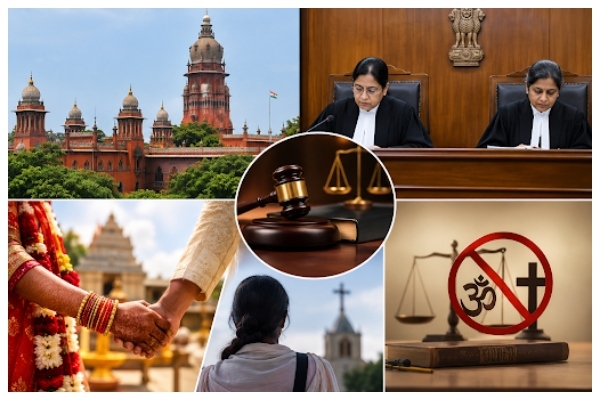
A Division Bench of Justice P.T. Asha and Justice N. Mala passed the order while dismissing a civil miscellaneous appeal filed by the woman against the Family Court in Villupuram.
The petitioner claimed that she married the respondent on July 10, 2008, according to Hindu rites and customs at a temple near Villupuram. She said that after the marriage, they lived together for some time.
According to her, the respondent later subjected her to cruelty and his mother and sister also physically abused her. She alleged that she was forced to leave the matrimonial home and that repeated attempts to return and resume married life were unsuccessful.
She then approached the Family Court seeking restitution of conjugal rights under Section 9 of the Hindu Marriage Act.
The alleged husband denied the claims, including the alleged relationship and marriage. He also argued that the woman was a Christian and therefore the alleged marriage could not be treated as a valid Hindu marriage under the HMA.
The Family Court examined the evidence and concluded that the woman had failed to prove that a valid marriage had taken place between the two.
The Court also found that she was a Christian by religion and that the alleged marriage did not qualify as a marriage under the Hindu Marriage Act. Therefore, she was not entitled to seek restitution of conjugal rights or any other relief under the Act.
The woman then challenged the Family Court's decision before the Madras High Court.
The High Court agreed with the Family Court's findings. The Bench noted that the woman's school records identified her as a Christian belonging to the Adi Dravidar community.
Madras HC holds Section 9 of Hindu Marriage Act cannot be read in isolation; where one party is Christian and the other Hindu, alleged marriage is not a Hindu marriage to which the HMA applies
— LawBeat (@LawBeatInd) September 5, 2026
Read More: https://t.co/QmKzQIXAM3 pic.twitter.com/7QcIBK8OxC
Her nephew had also appeared as a witness and stated that their family followed Christianity. Based on the documentary and oral evidence, the High Court concluded that the petitioner was a Christian.
Before the High Court, the woman's counsel argued that Section 9 uses the words "husband" and "wife" and does not specifically say "Hindu husband" or "Hindu wife".
Based on this, the counsel argued that both parties did not necessarily have to be Hindus for a petition under Section 9 to be maintainable.
The High Court rejected this argument and said that Section 9 cannot be read separately from the rest of the Hindu Marriage Act.
The Bench referred to the Preamble and Sections 2, 5, 7 and 9 of the Act to understand its overall purpose and scope.
The Court observed that an individual provision of a law cannot be read in isolation from the other provisions of the same law.
The Bench pointed out that the Preamble states that the Act was enacted to amend and codify the law relating to marriage among Hindus. Section 2 lays down who the Act applies to, while Section 5 states that a Hindu marriage may be solemnised between "any two Hindus", subject to the conditions prescribed by law.
The Court specifically rejected the argument that the use of the words "husband" and "wife" in Section 9 makes the provision applicable to non-Hindus.
The Court made it clear that the right to invoke Section 9 depends on fulfilling the requirements under Sections 2, 5 and 7 of the HMA.