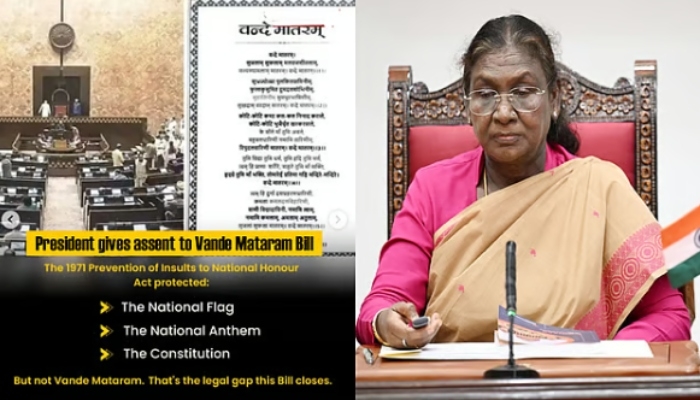
On Tuesday, August 11, President Droupadi Murmu gave assent to the Vande Mataram Bill, granting the National Song the same legal protection as the national anthem. Last month, Parliament passed the Prevention of Insults to National Honour (Amendment) Bill, 2026, which amends the original Prevention of Insults to National Honour Act of 1971. Under this amendment, Vande Mataram will now receive the same legal protection as the national anthem, Jana Gana Mana.
Having received presidential assent, the bill has now officially come into force as law. Offences under the Act are punishable with up to three years of imprisonment, a fine, or both. Previously, the Act only made it an offence to deliberately stop the singing of the national anthem or to disrupt any gathering where it was being sung. These offences were punishable by up to three years' imprisonment, a fine, or both, while a second and every subsequent conviction attracted a minimum of one year's imprisonment. The erstwhile law did not accord the same protection for the national song.
"Presently, there is no specific legal provision to prevent insults to the singing of 'Vande Mataram', which is honoured as the national song. Therefore, to prohibit any person from intentionally preventing the singing of the national song or causing disturbance to any assembly engaged in such singing, it is proposed to amend Section 3 of the said Act to include the national song also within its ambit, to make such acts punishable," the Bill had said.
"The president of the Constituent Assembly, Dr Rajendra Prasad, on January 24, 1950, stated that the song 'Vande Mataram' composed by Bankim Chandra Chatterjee, which played a historic role in the Indian freedom struggle, shall be honoured equally with the national anthem 'Jana Gana Mana' and shall have equal status with it," the Bill further said.
It is important to note that there have been several incidents in the past in which the song 'Vande Mataram' has been disrespected, interrupted, refused, or opposed by opposition parties like the Indian National Congress (INC), Samajwadi Party (SP), RJD, National Conference, etc.
1. Vande Mataram was allegedly stopped after only one line
In April 2018, at a Congress rally, Vande Mataram was cut short after Rahul Gandhi pointed to his watch and signaled K.C. Venugopal. Venugopal then reportedly instructed the organizers and the singer to finish the song 'Vande Mataram' in a single line due to time constraints.
2. SP's Barq said he would not sing Vande Mataram
In June 2019, Samajwadi Party lawmaker Shafiqur Rahman Barq refused to chant "Vande Mataram", saying "it's against Islam." After taking the oath, Mr Barq, who represents Uttar Pradesh's Sambhal constituency in the parliament, said, "Jahan tak Vande Mataram ka taaluq hai, it is against Islam; we cannot follow it (as far as Vande Mataram is concerned, it is against Islam, we cannot follow it."
#WATCH: Slogans of Vande Mataram raised in Lok Sabha after Samajwadi Party's MP Shafiqur Rahman Barq says, "Jahan tak Vande Mataram ka taaluq hai, it is against Islam we cannot follow it" after concluding his oath. pic.twitter.com/8Sugg8u8ah
3. Bhopal Congress MLA refused to sing Vande Mataram
In 2019, the Bhopal Central MLA Arif Masood belonging to the Congress party declined to recite Vande Mataram during a public event in Sehore district, stating that his religious beliefs under Shariat law did not permit him to sing it, though he maintained he was ready to serve the country otherwise.
"Why should I sing (Vande Mataram). I follow Shariat, which does not permit this. I am ready to lay my life for the country, ready to go to the border. But they insist on singing Vande Mataram. Our army fights at the border, not leaders," the Congress MLA was quoted as saying.
4. Siddaramaiah asked party workers not to sing Vande Mataram
On November 26, 2022, at a Constitution Day event at the Karnataka Pradesh Congress Committee office in Bengaluru, INC's Siddaramaiah initially told party workers that singing Vande Mataram was not required. The incident sparked massive outrage after the BJP slammed the leader for insulting the song. The leader then immediately corrected himself, stating they could sing it if they wished, and noted they were free to proceed.
In November 2025, Samajwadi Party MP Ziaurrahman Barq echoed his late grandfather Shafiqur Rahman Barq's stance, stating he has never sung Vande Mataram and refused to do so. He maintained that objecting to the song on religious grounds did not deserve to question his patriotism.
5. SP's Ziaurrahman Barq said he would never sing Vande Mataram
The Samajwadi Party (SP) in November 2025 also strongly demanded the immediate withdrawal of UP government directives making the singing of Vande Mataram compulsory in schools.
Also, recently, when the West Bengal government led by the BJP made singing of 'Vande Mataram' compulsory in schools, the All India Muslim Personal Law Board (AIMPLB) and other Islamic bodies strongly objected and demanded immediate withdrawal of the decision.
6. RJD MLA from Thakurganj did not stand up as Vande Mataram was played at monsoon session
Multiple incidents involving legislators declining to stand or sing Vande Mataram in the Bihar Legislative Assembly have occurred. Incidents involving AIMIM state chief Akhtarul Iman in December 2021 and RJD MLA Saud Alam in July 2022 sparked political controversy when they abstained from participating during the national song's rendition.
In July 2022, the Rashtriya Janata Dal (RJD) MLA from Thakurganj did not stand up as Vande Mataram played at the close of the monsoon session. He defended his actions outside the assembly by stating that India had not yet turned into a Hindu nation.
Watch: Rashtriya Janata Dal (@RJDforIndia) MLA Saud Alam refused to stand up for the “#VandeMataram” in the Bihar assembly.
In April 2026, two Congress women councillors in Indore, Madhya Pradesh, Fauzia Sheikh Alim and Rubina Iqbal Khan, declined to sing the national song during a municipal corporation meeting, stating that their religious beliefs and personal faith did not permit it.
Indore Municipal Corporation erupted in chaos during a budget session when a BJP councillor declared: "If you want to live in India, you must say 'Vande Mataram'!"
Congress councillor Fauzia Sheikh Aleem objected, saying it cannot be forced, and walked out of the house. pic.twitter.com/a1ZNsY025e
8. NC MP Aga Syed Ruhullah Mehdi declined to sing Vande Mataram
In December 2025, National Conference (NC) MP Aga Syed Ruhullah Mehdi declined to sing Vande Mataram during a parliamentary discussion in Lok Sabha, stating that certain verses conflict with his religious beliefs. His refusal caused immediate uproar, hooting, and heavy political debate over personal faith versus national symbols.
Significance of Vande Mataram for Indians
“Vande Mataram” holds a unique place in India’s history as a powerful expression of patriotism and devotion to the motherland. Written by Bankim Chandra Chattopadhyay in the 1870s and incorporated into his 1882 novel Anandamath, the song became a rallying cry during India’s freedom struggle. It was first sung publicly at the 1896 session of the Indian National Congress in Calcutta by Rabindranath Tagore.
During the Swadeshi Movement (1905–08), following the partition of Bengal, “Vande Mataram” became one of the most prominent slogans of resistance against British rule. Revolutionaries, freedom fighters and nationalists used it to inspire unity, courage and sacrifice.
After Independence, while “Jana Gana Mana” was adopted as India’s National Anthem, Vande Mataram was accorded the status of the National Song. This is probably the most important historical controversy. In 1937, the Congress Working Committee adopted only the first two stanzas for official use because the later portions contained explicit Hindu religious imagery. Amit Shah later characterised this as Congress having “divided” the song.
Thus, Vande Mataram is not merely a song; it is deeply associated with India’s freedom movement, national consciousness, sacrifice and the emotional idea of the motherland.
Cancel registration of Madarsas who refuse to sing Vande Mataram: BJP's Nitesh Rane
Vande Mataram is far more than a patriotic composition, it is a powerful symbol of India’s freedom struggle, national consciousness and reverence for the motherland. From the streets of the freedom movement to the institutions of independent India, its words have represented the courage, sacrifice and collective identity of generations of Indians. The song’s historic association with the struggle against British rule gives it a significance that goes beyond politics or ideology.
Therefore, any deliberate act of disrespect towards Vande Mataram can reasonably be viewed as an affront to the sentiments and national consciousness that the song represents. Maharashtra minister Nitesh Rane has gone further, arguing that those Madarsas who insult or refuse to respect Vande Mataram should give up their right to demand funds from the government. Such a position reflects the strong view that respect for national symbols is inseparable from respect for the nation itself.
Siddhi Somani is known for her satirical and factual hand in Economic, Social and Political writing. Having completed her post graduation in Journalism, she is currently engaged in completing her Masters in Politics. The author meanwhile is also exploring her hand in analytics and statistics.