Envisioning learning and human development in the age of AI through the lens of NEP 2020: The way forward
The AI-powered tools are already being integrated both actively and passively by educational institutions into teaching, assessment, administration, and student support systems. (NEP)
NewsBharati 05-Jun-2026 11:44:41 AM
Total Views |


India today stands at a unique educational crossroads. On one side lies the extraordinary rise of artificial intelligence (AI), and on the other lies the transformative vision of the National Education Policy 2020 (NEP), which seeks to redefine education in India through critical thinking, experiential learning, multidisciplinary education, and holistic human development. AI is rapidly transforming how information is accessed, processed, and consumed. Between these two developments emerges one of the defining questions. The question is “What does it mean to remain intelligent in an age where machines increasingly think for us?”
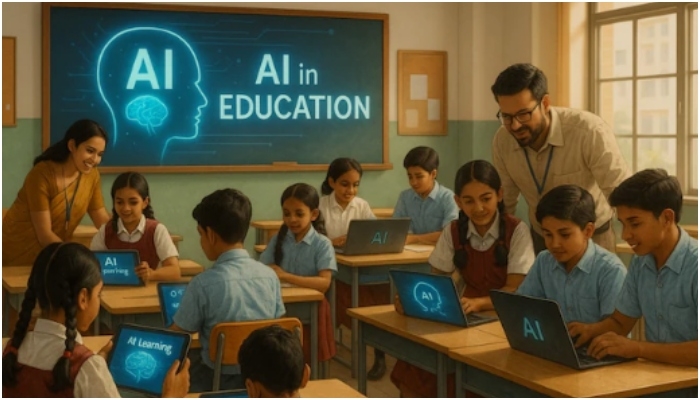
If artificial intelligence reduces the need to learn, then human development must respond by reasserting its importance. This does not imply a return to rote memorization or uncritical pedagogy. On the contrary, it calls for redefining learning as an intentional, reflective, and effortful process. In the age of AI, the value of learning lies not in the accumulation of information, but in the development of capacities that machines cannot easily replicate. This may involve, but is not limited to, the following:
In essence, how one engages with AI will decide intelligence and knowledge generation more than what one knows about. The NEP-2020 precisely aims to achieve this by adopting a multipronged, multidisciplinary approach to learning and understanding various subjects.
One of the most important recommendations from the perspective of NEP 2020 is the need to move from rote learning toward reflective and inquiry-based learning. Therefore, educational institutions must consciously cultivate environments where learners are encouraged to ask questions, examine assumptions, and engage deeply with concepts. The real purpose of education should no longer be the reproduction of information, but the development of understanding as enunciated in NEP-2020.
Further, NEP 2020’s emphasis that learning should emerge through observation, experimentation, discussion, projects, field engagement and real-life problem-solving will augment the learning process. Such an approach is essential in the AI age because reflective understanding develops only when learners actively interact with knowledge rather than passively receive outputs.
Another important recommendation is the strengthening of multidisciplinary education. Artificial intelligence is transcending the traditional boundaries between disciplines. Problems related to climate change, ethics, governance, mental health, technology, and social inequality can no longer be understood through isolated domains of a particular discipline. NEP 2020 recognizes this by encouraging flexible and multidisciplinary learning structures.
Re-focussing Learning in Human Development: Changing role of learners, teachers and Education
Students in the AI era must therefore develop the ability to connect scientific knowledge with philosophy, technology with ethics and innovation with social responsibility. Such integrative learning will strengthen creativity, contextual understanding and problem-solving ability. More importantly, it prevents knowledge from becoming fragmented and purely technical.
Further, in view of this, the students should be taught AI literacy as part of contemporary education. This does not simply mean learning how to use AI tools. It should be about understanding:
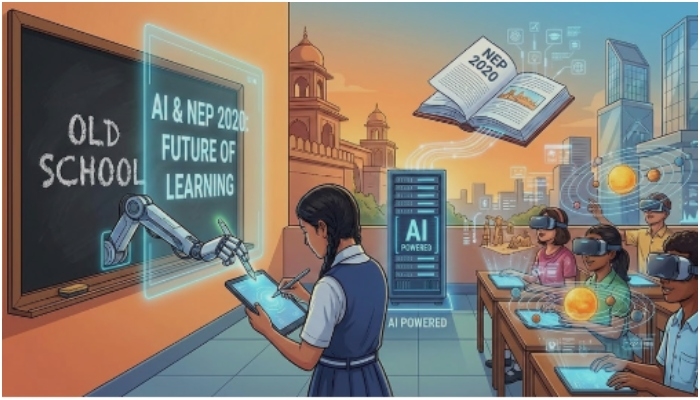 In the AI age, teachers cannot remain mere transmitters of information because information itself has become universally accessible. Their role must shift toward mentorship, facilitation, ethical guidance and cognitive development. Teachers must help students interpret knowledge, navigate uncertainty and cultivate reflective thinking. In many ways, the future teacher will become less of an instructor and more of a guide in the learner’s intellectual and human journey. The pedagogy and the role of teachers will also need to evolve significantly. The imminent challenges in faculty development will be key to the future educational development using AI. At present, the Institutional support for faculty training and interdisciplinary collaboration needs to be augmented for the development of a comprehensive understanding of AI, its usage, and ethics in education.
Artificial intelligence may transform how humans work, communicate, and access knowledge, but the future of civilization will still depend on deeply human capacities—the ability to reflect, to question, to imagine, and to act responsibly. The challenge before education is therefore not merely technological adaptation, but the preservation of intellectual depth and human meaning.
The Divide Imminent: The AI Users & The AI Non-Users?
The world has grown rapidly from the stage of knowers and know-nots in the information age. Now it is often stated that the future will be divided between those who use AI and those who do not. Perhaps, this is a little misleading formulation. Access to AI is rapidly expanding; its use will become ubiquitous and all-pervasive in times to come as was seen in the case of the Internet.
The more significant divide between the developed and less developed learning communities will be between:
The first group is likely to develop more robust cognitive abilities due to their adaptability to use and leverage AI as a partner in inquiry. The latter group may achieve efficiency with the use of AI, but it will be at the cost of intellectual growth and development, which may make them lose cognitive independence. The challenge for the teachers is to design environments where AI enhances, rather than displaces, the development of human intelligence. It will be pertinent to state that in a world where answers are almost readily available, learning may become less of a necessity and more of a choice. This is perhaps the most consequential shift of all.
Artificial intelligence and its relatable ecosystem of algorithms will continue to evolve, becoming more capable, engaging, and more integrated into the everyday life of humans. The question is not whether it will change how we think, as it already has started doing this. The question is whether we will allow it to replace the processes that make thinking possible.
Machines may become smarter, but humanity must become wiser. The societies that endure may not be those that produce the fastest technologies, but those that preserve the deepest forms of human understanding. The future of intelligence lies in a renewed commitment to learning, Deliberate, Effortful, and Reflective. And perhaps, in an age dominated by artificial intelligence, the rarest and most revolutionary act will be to remain capable of original thought, reflective silence, and meaningful Chintana.
Artificial intelligence has fundamentally altered the landscape of learning in the recent past. (NEP). AI systems today can generate essays, summarize books, solve mathematical problems, create presentations, and simulate conversation with remarkable fluency. The AI-powered tools are already being integrated both actively and passively by educational institutions into teaching, assessment, administration, and student support systems.
If artificial intelligence reduces the need to learn, then human development must respond by reasserting its importance. This does not imply a return to rote memorization or uncritical pedagogy. On the contrary, it calls for redefining learning as an intentional, reflective, and effortful process. In the age of AI, the value of learning lies not in the accumulation of information, but in the development of capacities that machines cannot easily replicate. This may involve, but is not limited to, the following:
The ability to frame meaningful questions
To sustain attention over time
To evaluate competing claims
To act with ethical judgment
In the wake of the above discussion, it can be reiterated that the National Education Policy 2020 becomes especially significant. NEP 2020 is not merely an educational reform document. It is a philosophical framework for preparing learners for a rapidly changing world. Its emphasis on critical thinking, experiential learning, creativity, multidisciplinary education, ethical reasoning, and holistic development offers a meaningful pathway for responding to the cognitive and developmental challenges emerging in the age of AI. The way forward therefore lies not in resisting artificial intelligence, but in reshaping education so that technology strengthens rather than replaces human intelligence.
One of the most important recommendations from the perspective of NEP 2020 is the need to move from rote learning toward reflective and inquiry-based learning. Therefore, educational institutions must consciously cultivate environments where learners are encouraged to ask questions, examine assumptions, and engage deeply with concepts. The real purpose of education should no longer be the reproduction of information, but the development of understanding as enunciated in NEP-2020.
Further, NEP 2020’s emphasis that learning should emerge through observation, experimentation, discussion, projects, field engagement and real-life problem-solving will augment the learning process. Such an approach is essential in the AI age because reflective understanding develops only when learners actively interact with knowledge rather than passively receive outputs.
It is also important to note that modern digital culture promotes speed, immediacy, and constant stimulation. In this scenario, students often tend to move rapidly from one piece of information to another without allowing ideas to settle into understanding. In contrast, Indian learning traditions emphasized Chintana, i.e., deep contemplation and sustained reflection. NEP 2020’s vision of holistic development indirectly resonates with this idea by emphasizing critical inquiry, ethical reasoning, self-awareness, and creativity.
Another important recommendation is the strengthening of multidisciplinary education. Artificial intelligence is transcending the traditional boundaries between disciplines. Problems related to climate change, ethics, governance, mental health, technology, and social inequality can no longer be understood through isolated domains of a particular discipline. NEP 2020 recognizes this by encouraging flexible and multidisciplinary learning structures.
Re-focussing Learning in Human Development: Changing role of learners, teachers and Education
Students in the AI era must therefore develop the ability to connect scientific knowledge with philosophy, technology with ethics and innovation with social responsibility. Such integrative learning will strengthen creativity, contextual understanding and problem-solving ability. More importantly, it prevents knowledge from becoming fragmented and purely technical.
Further, in view of this, the students should be taught AI literacy as part of contemporary education. This does not simply mean learning how to use AI tools. It should be about understanding:
How Algorithms Shape Knowledge
How Biases Emerge In Technological Systems
How Misinformation Spreads
How Digital Tools Influence Human Cognition and Behaviour
While redefining the broader goal of education, NEP 2020 repeatedly emphasizes holistic development and the creation of responsible, thoughtful, and ethical individuals. This gains relevance in a rapidly transforming world, which is increasingly being shaped by intelligent machines. Human development cannot be reduced to employability, technical efficiency, or productivity alone. Education must continue to nurture empathy, social consciousness, creativity, ethical awareness, and self-understanding.
Artificial intelligence may transform how humans work, communicate, and access knowledge, but the future of civilization will still depend on deeply human capacities—the ability to reflect, to question, to imagine, and to act responsibly. The challenge before education is therefore not merely technological adaptation, but the preservation of intellectual depth and human meaning.
The Divide Imminent: The AI Users & The AI Non-Users?
The world has grown rapidly from the stage of knowers and know-nots in the information age. Now it is often stated that the future will be divided between those who use AI and those who do not. Perhaps, this is a little misleading formulation. Access to AI is rapidly expanding; its use will become ubiquitous and all-pervasive in times to come as was seen in the case of the Internet.
The more significant divide between the developed and less developed learning communities will be between:
Those who use AI to support and deepen learning and
Those who use AI to replace learning altogether.
Artificial intelligence and its relatable ecosystem of algorithms will continue to evolve, becoming more capable, engaging, and more integrated into the everyday life of humans. The question is not whether it will change how we think, as it already has started doing this. The question is whether we will allow it to replace the processes that make thinking possible.
Machines may become smarter, but humanity must become wiser. The societies that endure may not be those that produce the fastest technologies, but those that preserve the deepest forms of human understanding. The future of intelligence lies in a renewed commitment to learning, Deliberate, Effortful, and Reflective. And perhaps, in an age dominated by artificial intelligence, the rarest and most revolutionary act will be to remain capable of original thought, reflective silence, and meaningful Chintana.

Saunand Somasi
Two decades (Twenty Two years) of award winning experience in Education industry with expertise Education Policy, Planning & Management, Program Development, General Administration, Research & Development along with establishment of IGNOU regional & study centres at remote locations. Chaired and Co-chaired sessions on International and National platforms with UNICEF, UNESCO, AICTE, Commonwealth Youth Programme (CYP), NCERT and KVS.