"The Ancient Wisdom Behind Dr. Bhagwat’s US Speech”
NewsBharati 31-Aug-2026 13:32:55 PM
Total Views |


Those familiar with the ideological and philosophical tradition of the Rashtriya Swayamsevak Sangh (RSS) would not have been surprised by the substance of Dr. Mohan Bhagwat’s speech in the United States. What he said was neither a sudden formulation nor an attempt to construct a new philosophy for a foreign audience. It was, in essence, the articulation of an idea that has lived in Indian civilization for centuries. Dr Bhagwat was not inventing a message. He was carrying forward a message.
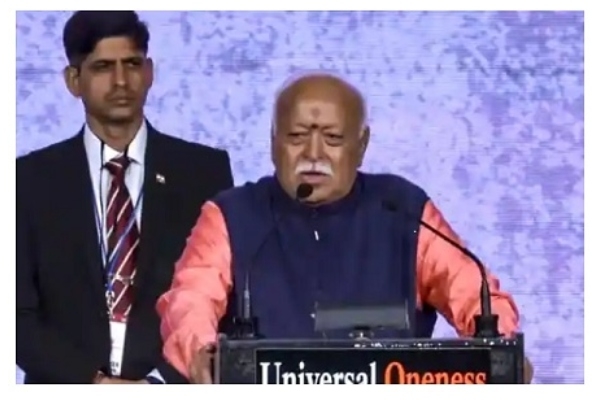
This distinction is important. Much of what is described today as the “RSS worldview” is, at its philosophical core, deeply rooted in the civilisational experience of India. The organisation may be young, having been founded in 1925, but many of the ideas associated with its social and cultural outlook are deeply rooted in ancient Indian ideology. They belong to an Indian tradition that predates modern political categories and cannot be adequately understood through the vocabulary of Western nationalism, politics or ideology alone.
The same civilisational temperament can be seen in the Hindu understanding of dharma. Dharma is not merely religion in the narrow institutional sense. It encompasses duty, responsibility, ethical conduct, social harmony and the larger order that sustains individual and collective life. It asks not merely what rights an individual possesses, but also what responsibilities accompany those rights.
This is one reason why Dr Bhagwat’s emphasis on harmony, coexistence and the larger human good resonates with the deeper Indian tradition. The Hindu civilisation developed within a framework in which plurality was not necessarily regarded as a problem requiring elimination. Different philosophical schools, paths of worship, spiritual practices and interpretations of the ultimate reality could coexist within the same civilisational space.
ALSO READ: Security Forces Bust Naxal Explosives Dump in Sukma, Recover IEDs and Detonators
The RSS’s conception of Hindu society is similarly broader than a narrow religious definition. Hindutva, in the civilisational sense in which the RSS uses the term, is fundamentally connected with the cultural and historical identity of India. It seeks to understand India as a civilisation whose continuity has survived political upheavals, invasions, colonial rule and enormous social transformations. For the RSS, therefore, the idea of Hindu civilisation is not simply about the past. It is about continuity.
That continuity is particularly significant when Dr Bhagwat speaks outside India. In the United States, he is addressing a society shaped by a different historical experience and by a different intellectual vocabulary. But the message he carries does not need to be altered to become universal. Its universal character comes precisely from its civilisational foundation. An Indian idea does not become universal by abandoning its Indian identity. It becomes universal when its underlying human values can speak to people beyond geographical boundaries.
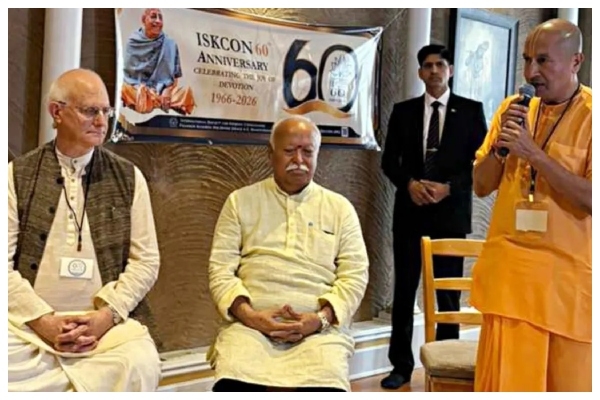
This is precisely where the significance of Dr Bhagwat’s American speech lies. India’s civilisational contribution has historically been less about converting the world to a single belief system and more about offering ways of thinking about human existence. Yoga travelled beyond India because it addressed the relationship between body, mind and consciousness. Ayurveda attracted global attention because it offered an integrated understanding of health and life. Meditation crossed cultural boundaries because the human mind is not confined by national borders.
Similarly, the Indian philosophy of coexistence and interconnectedness can have relevance far beyond India. Dr Bhagwat’s words also represent a particular confidence that has become increasingly visible in contemporary India: the confidence to speak about Indian civilisation without embarrassment. For generations, the Indian intellectual conversation was often conducted through borrowed frameworks. Indian traditions were explained through Western categories, and their legitimacy was sometimes sought through external approval.
That approach is changing. The emerging India increasingly believes that its civilisational inheritance can be presented in its own vocabulary while remaining open to the world. Dr Bhagwat’s presence in America represents that confidence. He does not have to choose between being Indian and being universal. The two are perfectly compatible.
These principles are deeply embedded in the Indian experience. That is why those familiar with RSS thought are unlikely to regard Dr Bhagwat’s American speech as a departure. They would recognise it as a continuation a contemporary expression of ideas that India has carried across centuries. Dr Bhagwat was speaking in America, but the philosophical roots of his message were unmistakably Indian. He was speaking to a modern global audience, but he was drawing upon an ancient civilization vocabulary.
The significance lies precisely in that meeting of time and place - an ancient Indian worldview finding expression in a modern global setting. The RSS is merely carrying the message forward.

Editor's Desk
Editor's Desk